


AI tools are now part of daily work for a large share of employees. Surveys from the European Central Bank, McKinsey, Gartner and Stanford show fast growth in use and spending.
The results are mixed. Workers report saving hours each week, yet most executives say they see no measurable gain in company output.
This article reviews the latest 2026 data on adoption, spending, time savings, task results and business outcomes. Each section includes a chart and the key figures behind it.
How Many Workers Use AI?
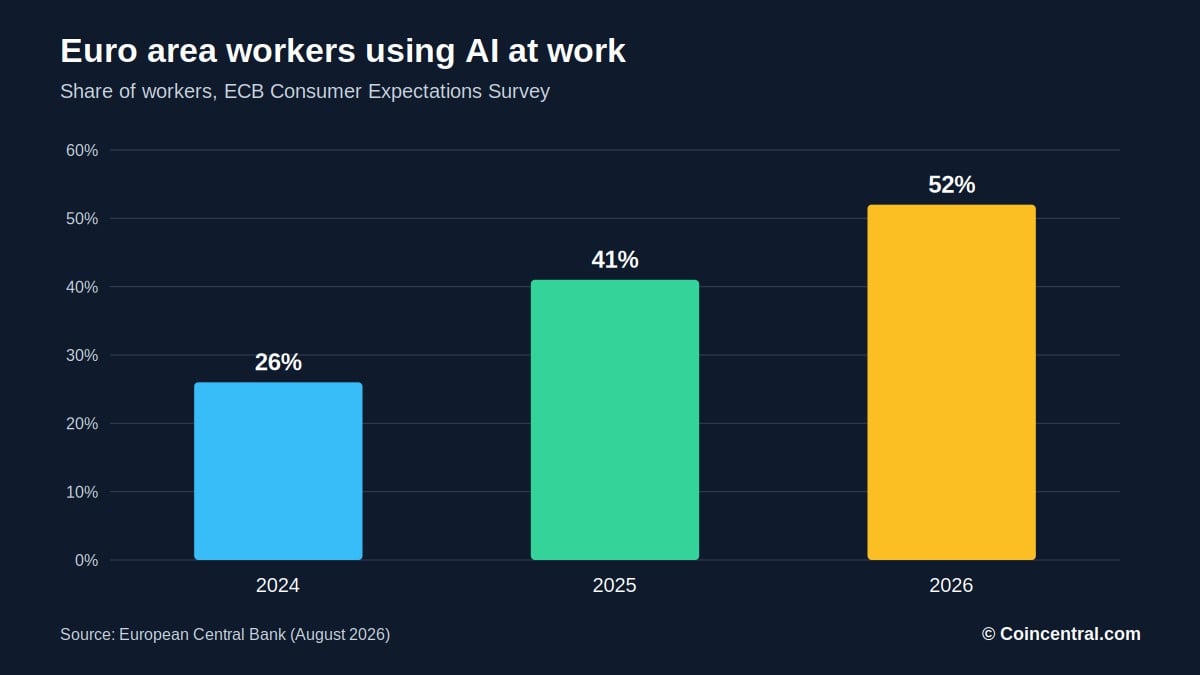
The share of workers using AI has grown quickly in the past two years. The European Central Bank (ECB) tracks it through a monthly survey of about 20,000 people in 11 euro area countries. Use at work rose from 26% in 2024 to 41% in 2025 and reached 52% in 2026.
Workers who use AI do so about three days a week on average. Age and education explain most of the gap between groups. Among highly educated workers, 61% use AI, compared with 37% of those with lower education.
Younger workers are about 20 percentage points more likely to use AI than older colleagues. Men report slightly higher use than women. Once people start, they use AI at similar rates, with group averages between 2.5 and 2.9 days a week.
Other surveys point the same way, though the numbers differ by group. Microsoft’s 2025 Work Trend Index surveyed 31,000 knowledge workers in 31 markets. It found that 75% use AI at work.
Gallup surveyed U.S. employees and found that 45% used AI at least a few times a year by the third quarter of 2025. Daily use stood at 10%. Use varied by industry, from 76% in technology to 33% in retail.
Stanford’s 2026 AI Index reports that 88% of organizations use AI in at least one business function. It also found that generative AI reached 53% of the population within three years. That is faster than the personal computer or the internet.
Adoption differs by country. The United Arab Emirates reached 64% and Singapore 61%, while the United States ranked 24th at 28.3%. The Index says adoption tracks closely with national income per person.
| Source | Group measured | Share using AI |
|---|---|---|
| ECB (2026) | Euro area workers | 52% |
| Microsoft (2025) | Knowledge workers, 31 markets | 75% |
| Gallup (Q3 2025) | U.S. employees, at least a few times a year | 45% |
| Gallup (Q3 2025) | U.S. employees, daily | 10% |
| Stanford AI Index (2026) | Organizations, at least one function | 88% |
How Much Is the World Spending on AI?
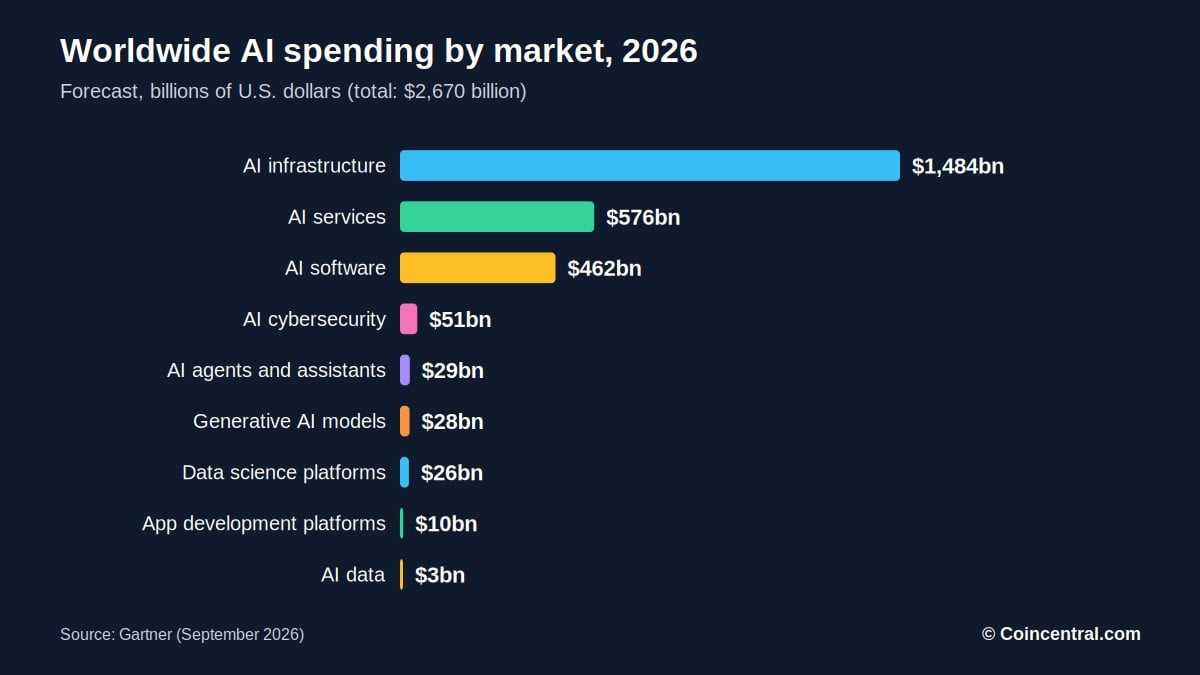
Gartner forecasts that worldwide AI spending will reach $2.7 trillion in 2026. That is a 49.5% increase from 2025, when spending was about $1.79 trillion. The firm expects $3.64 trillion in 2027.
Infrastructure is the largest category. Spending on AI infrastructure is forecast at $1.48 trillion in 2026, or about 56% of the total. Gartner analyst John-David Lovelock described the build-out of AI data center capacity as the largest infrastructure project humanity has undertaken.
AI services are forecast at $576 billion and AI software at $462 billion. Smaller categories are growing fast from a low base. AI cybersecurity spending is expected to roughly double, from $25.9 billion to $51.3 billion.
Spending on generative AI models is forecast to rise from $13.0 billion to $28.3 billion. AI agents and assistants are forecast to grow from $16.5 billion to $29.2 billion. Gartner raised its 2026 growth forecast for generative AI models from 110% to 117%.
Gartner places generative AI in the Trough of Disillusionment in 2026. In its view, companies are choosing simpler AI features built into software they already use. Vendors are adding AI agents to existing products to defend their market share.
Gartner also expects a $1.2 trillion opportunity in AI services by 2030. Stanford’s AI Index adds a view of private investment. U.S. private AI investment reached $285.9 billion in 2025, more than 23 times the $12.4 billion invested privately in China.
The Index cautions that private figures likely understate China’s total spending, because government guidance funds are not counted.
| Market ($ billions) | 2025 | 2026 | 2027 |
|---|---|---|---|
| AI infrastructure | 981.9 | 1,484.4 | 1,977.7 |
| AI services | 434.0 | 576.5 | 745.7 |
| AI software | 288.2 | 461.6 | 656.4 |
| AI cybersecurity | 25.9 | 51.3 | 86.0 |
| AI agents and assistants | 16.5 | 29.2 | 65.5 |
| Generative AI models | 13.0 | 28.3 | 51.6 |
| Total AI spending | 1,786.7 | 2,670.5 | 3,637.3 |
How Much Time Does AI Save?
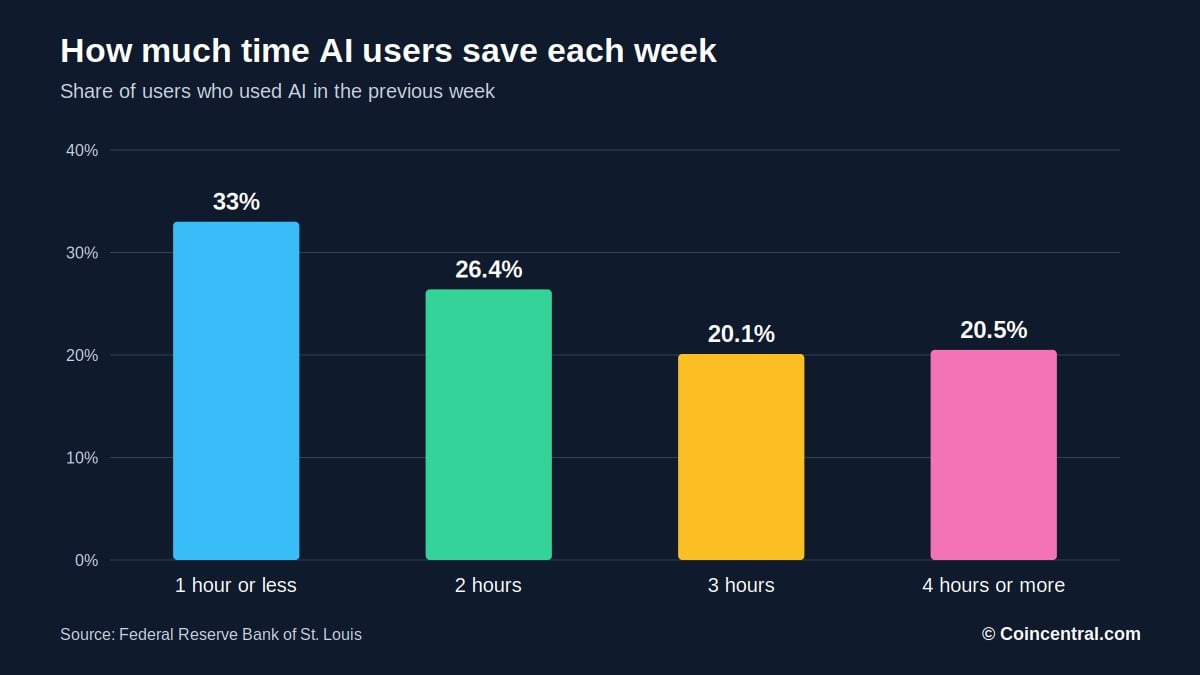
Two large surveys put a number on time savings. The Federal Reserve Bank of St. Louis found that generative AI users saved 5.4% of their work hours. In a 40-hour week, that is about 2.2 hours.
Savings were uneven. Among users who used AI in the previous week, 33% saved one hour or less and 26.4% saved two hours. Another 20.1% saved three hours, and 20.5% saved four hours or more.
The ECB found larger savings. The median euro area user reports saving three hours a week, or about 7.7% of median working time. The ECB notes that its survey allowed answers of up to 15 hours, while the St. Louis survey capped savings at four.
Both studies say the gain looks smaller across the whole workforce. Only 48.8% of euro area workers use AI and save time, so the ECB puts the economy-wide efficiency gain closer to 3.8%. The St. Louis estimate for all workers is a 1.1% rise in productivity.
The ECB also looked at which tasks save the most time. Generating or debugging code saves nearly eight hours a week, yet only about 8% of workers use AI for it. Research, writing and text editing are more common uses, but they save less time.
Saved time does not always become extra output. The ECB says workers must turn freed hours into useful work, and employers must be able to use the spare capacity. Estimates of added annual productivity growth from AI over ten years range from 0.1% to 3.4%.
Microsoft’s survey shows the tension. It found that 90% of AI users say the tools save them time. Yet 48% of employees and 52% of leaders describe their work as chaotic and fragmented.
| Study | Measure | Result |
|---|---|---|
| Federal Reserve Bank of St. Louis | Average share of hours saved by users | 5.4% (about 2.2 hours a week) |
| Federal Reserve Bank of St. Louis | Estimated gain across all workers | 1.1% |
| ECB | Median hours saved by users | 3 hours a week (7.7%) |
| ECB | Estimated gain across all workers | 3.8% |
How Large Are AI Gains on Specific Tasks?
Field experiments find real gains on specific tasks. They usually fall between 15% and 60%, depending on the work. The International AI Safety Report 2026 says gains run 20% to 60% in controlled settings and 15% to 30% in most real workplaces.
The size of the gain follows how structured the task is. Work with a clear right answer that is easy to check shows the biggest improvement. Work that needs open-ended judgment shows smaller gains, and sometimes losses.
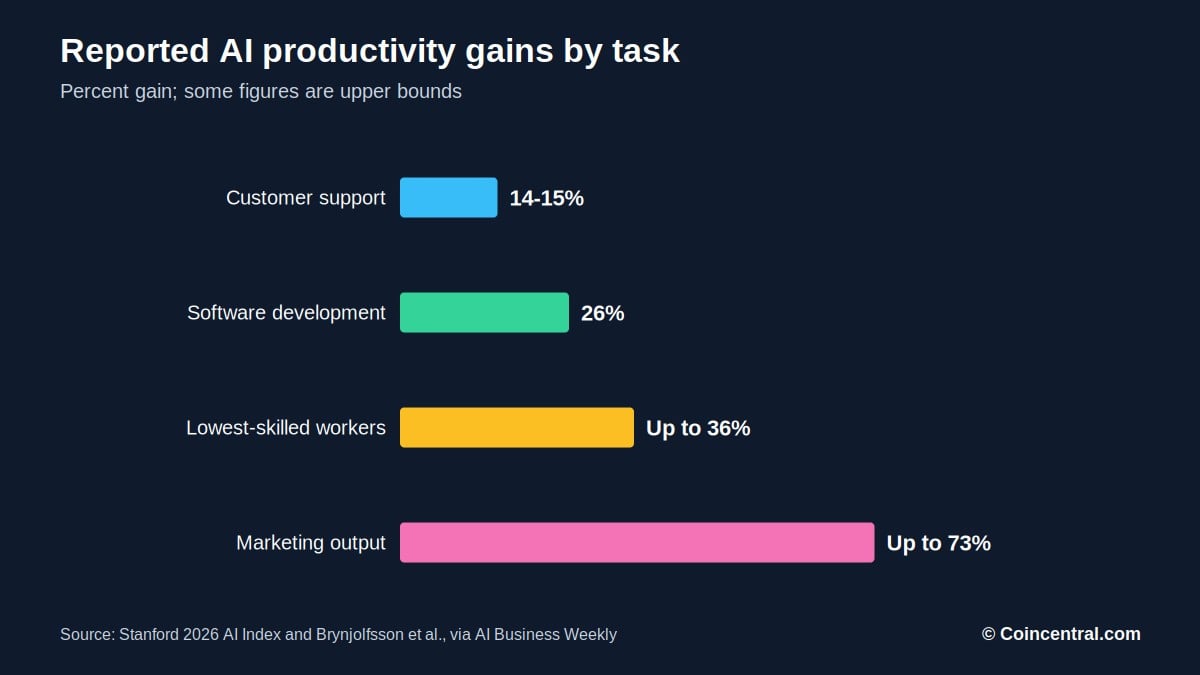
In customer support, studies cited in Stanford’s 2026 AI Index show gains of 14% to 15%. Software development shows 26%. Marketing output shows gains of up to 73%.
Research by Brynjolfsson and colleagues found that the lowest-skilled workers gained up to 36%. Apollo Technical reports that workers using generative AI finished writing and summary tasks about 40% faster. Independent judges rated the quality of that work about 18% higher.
Gains are not guaranteed. A METR study followed experienced open-source developers. They took 19% more time on coding tasks when using AI, yet believed they were working 20% faster.
Researchers call this uneven pattern the jagged frontier. Stanford’s Index gives an example. One AI model won a gold medal at the International Mathematical Olympiad, yet the top model reads analog clocks correctly only 50.1% of the time.
AI agents have improved quickly. On the OSWorld test, task success rose from 12% to about 66%. They still fail roughly one in three attempts on structured benchmarks.
| Task type | Reported gain | Source |
|---|---|---|
| Customer support | 14-15% | Stanford 2026 AI Index |
| Software development | 26% | Stanford 2026 AI Index |
| Marketing output | Up to 73% | Stanford 2026 AI Index |
| Lowest-skilled workers | Up to 36% | Brynjolfsson et al. |
| Real-world settings overall | 15-30% | International AI Safety Report 2026 |
| Experienced developers (METR) | 19% slower | METR study |
Do Companies See the Same Results?
At the company level, the picture is less clear. A National Bureau of Economic Research (NBER) study surveyed nearly 6,000 executives in the U.S., U.K., Germany and Australia. It found that 89% saw no measurable effect from AI on their firm’s productivity over the past three years.
More than 90% also reported no effect on employment. Executives expect modest change ahead. They predicted a 1.4% rise in productivity and a 0.5% fall in employment over the next three years.
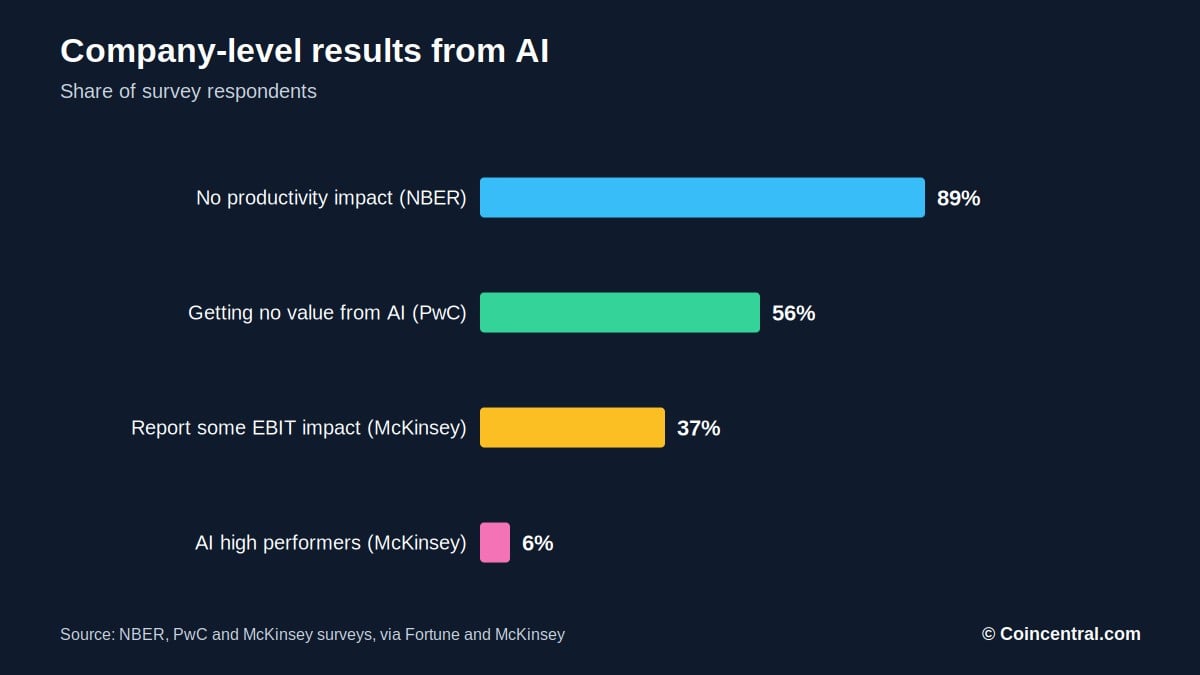
The study also found that executives use AI sparingly. Two-thirds use it, but the average is 1.5 hours a week, and 25% do not use it at all. PwC’s 29th Annual Global CEO Survey found that 56% of companies report getting nothing from their AI efforts.
McKinsey’s 2026 survey of 1,719 people in 97 countries shows a similar split. Eighty percent say AI has improved their own productivity, and 50% say it helps them make better decisions. Yet only 37% report any positive effect on earnings before interest and taxes (EBIT), about the same as last year.
McKinsey calls firms that attribute at least 5% of EBIT to AI “high performers.” They make up about 6% of respondents, unchanged from 2025. Most organizations have not yet turned individual gains into financial results.
The Federal Reserve Bank of Atlanta calls this a productivity paradox. Executives see gains that are larger than what shows up in revenue. The Bank’s explanation is delayed output, since gains appear in individual work before they reach company results.
The Atlanta Fed’s data suggest the gap may be narrowing in some sectors. High-skill services and finance report mean gains of 3.0% for 2026. Implied productivity growth from harder financial data is closer to 1.8% to 1.9%.
Why Do Large Firms Move Faster?
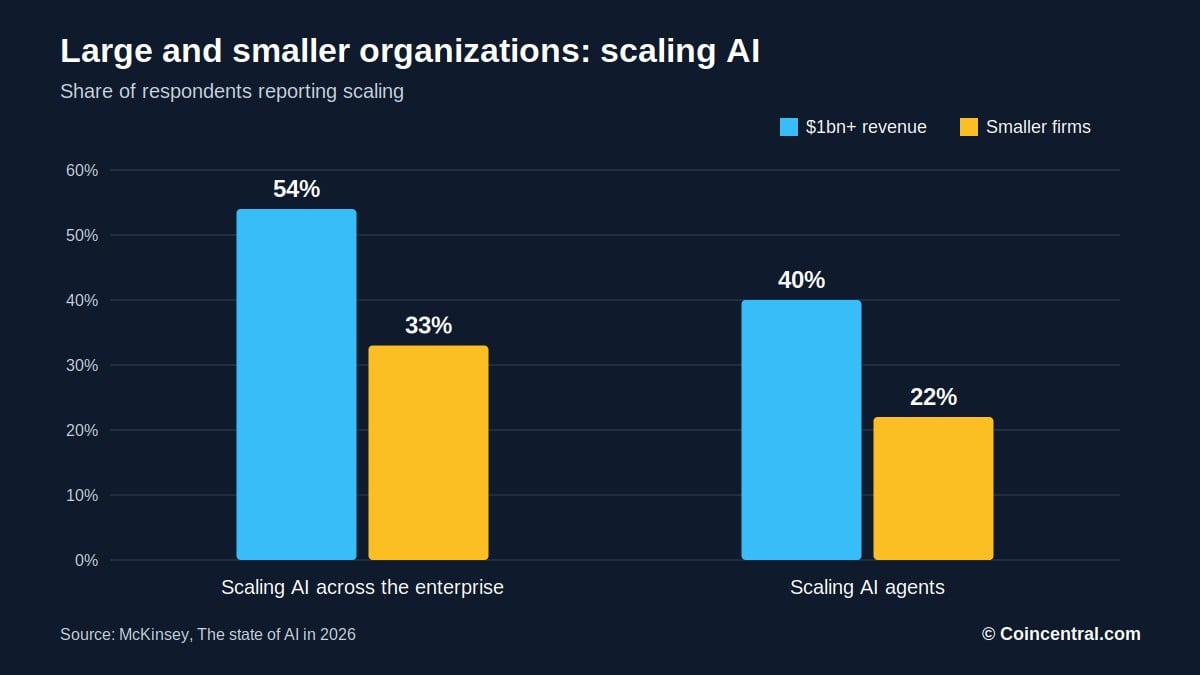
McKinsey finds that large organizations are ahead. Among firms with at least $1 billion in annual revenue, 54% report scaling AI across the enterprise. For smaller firms the figure is about one-third.
The gap is wider for AI agents, which can act on their own across workflows. At large firms, the share scaling agents rose from 27% to 40%. At smaller firms it stayed flat at 22%.
Chatbots are the most widely scaled tool, at 47% of respondents. About two in ten report scaling AI agents or software coding agents. Coding tools are changing buying decisions, since 32% of respondents say they chose not to buy at least one software product because they could build it in-house.
Costs are starting to matter. About one in five respondents say operating costs, including token fees, limit their AI use. Even so, 28% spend more than 10% of their technology budget on AI, and 60% expect to raise AI investment next year.
A separate set of figures from Zebracat points the same way. It reports that 44% of large enterprises with 5,000 or more staff use AI extensively, compared with 27% of small businesses with under 500. These figures come from a vendor-compiled collection, so they are best read as a rough guide.
McKinsey says high performers differ in how they use AI, not only in how much they spend. Nearly three-quarters have redesigned workflows because of AI, up from 55% last year. Only about one-quarter of other firms have done so.
| Measure | High performers | Other firms |
|---|---|---|
| Fundamentally redesigned workflows | Nearly 75% | About 25% |
| Decided against buying software built in-house | Nearly half | 31% |
| Expect to raise AI investment by 10% or more | More than half | 36% |
| Senior leaders show commitment to AI | Twice as likely | Baseline |
What Is Happening With Jobs and Barriers?
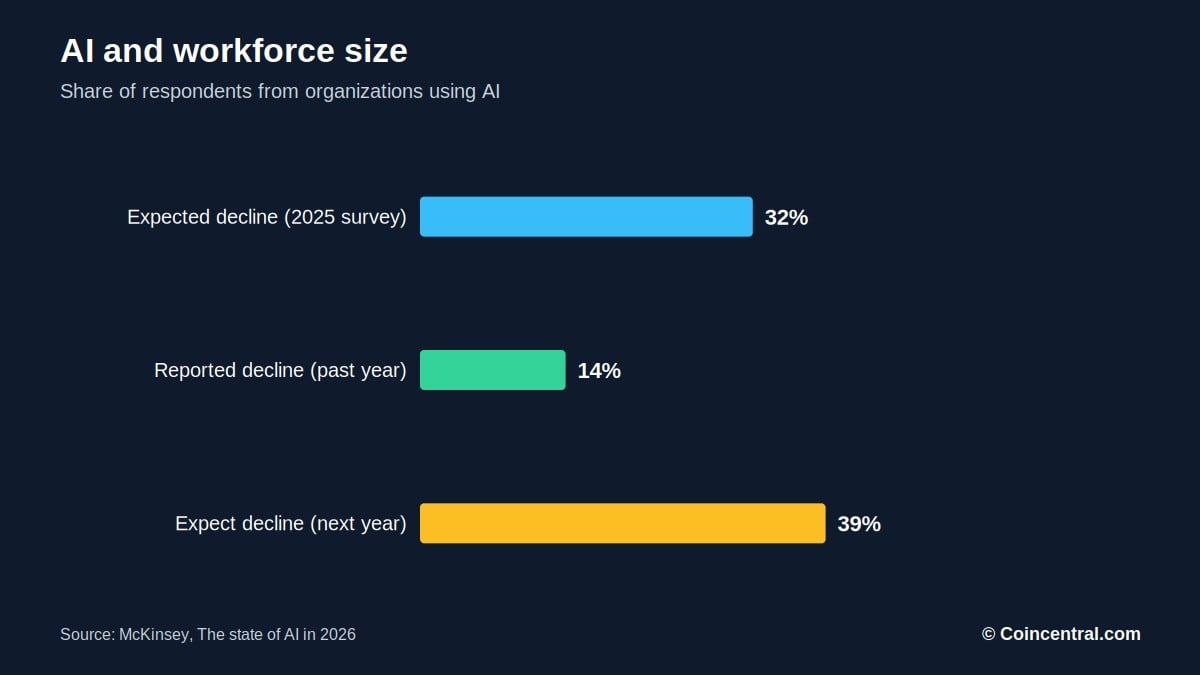
Fears about job losses have run ahead of results so far. In McKinsey’s survey, 14% of respondents from AI-using organizations said AI contributed to a smaller workforce in the past year. In last year’s survey, 32% had expected a decline over that period.
Two-thirds report little or no AI-related change in total employment. Looking ahead, 39% expect AI to reduce head count next year, while 43% expect little or no change. Only 13% say AI makes them anxious about their own career prospects.
Other research shows modest effects. One study cited by AI Business Weekly expects aggregate employment to fall by less than 0.4% because of AI in 2026. It expects routine clerical roles to fall by more than 2 percentage points over three years, offset by growth in technical roles. The ECB adds that there is so far no evidence of AI reducing total employment at the firm level.
Barriers to use remain. In the ECB survey, about one-third of non-users say AI is not relevant to their tasks. Others prefer traditional methods, worry about accuracy, or lack access from their employer.
In all, 41% of workers say they are uninterested in AI, including 34% of managers. When asked what would help, about half point to better training and a clearer understanding of how AI is useful. About half of firms plan to invest in AI training over the next 12 months.
Views of AI have softened slightly. The share of euro area workers with a positive view fell from 43% to 41%. ManpowerGroup found that regular AI use rose 13 percentage points to 45% of workers, while worker confidence fell by 18%.
| ECB finding | Share of workers |
|---|---|
| Do not use AI because it is irrelevant to their tasks | About one-third |
| Uninterested in using AI | 41% |
| Uninterested in using AI (managers) | 34% |
| Would be encouraged by better training or clearer usefulness | About half |
| View AI positively (down from 43%) | 41% |
Conclusion
The 2026 data shows that AI use at work is widespread and growing. Across the ECB, Microsoft, Gallup and Stanford surveys, between about half and three-quarters of workers now use AI in some form.
Individual results are clear. Users report saving between 2.2 and 3 hours a week, and task studies show gains of 15% or more on structured work. Company-level results are harder to see, with 89% of executives reporting no measurable productivity change.
Experts offer two explanations. One is delayed measurement, and the other is that most firms have not redesigned their workflows. Training, leadership support and workflow fit appear to matter more than adoption alone.
Spending is set to keep rising, with Gartner forecasting $3.64 trillion in 2027. Whether company results catch up with individual gains is the main question for the next set of surveys.
Sources
- Gartner Forecasts Worldwide AI Spending to Grow 49.5% in 2026
- ECB Blog: AI adoption and the productivity promise: what workers report
- McKinsey: The state of AI in 2026: On the road to ROI
- Stanford HAI: The 2026 AI Index Report
- AI Business Weekly: AI Productivity Statistics 2026: The Real Data
- Speakwise: AI Productivity Tools Statistics 2026
- Zebracat: 80+ AI Productivity Statistics That Show How It’s Changing Work (2026)