



Key Highlights
- Brent crude tumbled more than 6% to approximately $90.93 per barrel Monday following Washington’s decision to halt Iran bombing operations
- Last week saw Brent temporarily breach the $100 per barrel threshold as hostilities expanded into Red Sea waters
- The U.S. suspended military action following 13 straight nights of strikes, citing a need to create room for diplomatic solutions
- Tehran announced it would hold off on counter-strikes provided Washington maintains its cessation
- Maritime traffic disruptions persist through critical chokepoints including the Strait of Hormuz and Bab el-Mandeb despite the military pause
Crude markets experienced a substantial decline Monday following Washington’s announcement that it would suspend ongoing military operations targeting Iran, sparking renewed optimism for diplomatic resolution and eliminating the conflict-related premium that had recently driven prices to triple digits.
Brent crude plummeted over 6% to reach $90.93 per barrel. West Texas Intermediate saw a comparable 6.1% decline, settling at $83.83 per barrel. Both benchmark contracts momentarily breached critical technical support thresholds before staging modest recoveries.
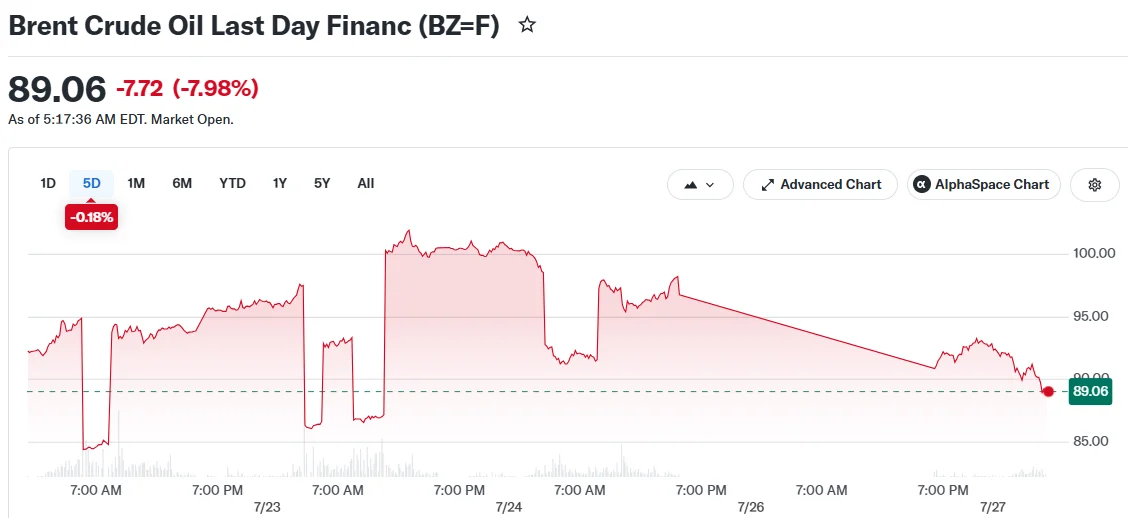
During the previous week, Brent had climbed back above the $100 per barrel mark for the first occasion since May. This surge materialized as military confrontations between Washington and Tehran spread from the Strait of Hormuz region into Red Sea territories.
Catalysts Behind the Price Decline
The United States refrained from launching additional strikes following nearly two weeks of continuous bombardment targeting Iranian military installations. President Trump’s United Nations representative indicated the administration was “providing diplomatic channels some breathing room.”
Tehran reciprocated by announcing a temporary suspension of retaliatory operations against neighboring countries, contingent upon Washington maintaining its military freeze. Both nations cautioned that hostilities could quickly resume should negotiations fail.
Iranian officials also reported meaningful advancement in consultations with Oman focused on ensuring secure maritime transit through the Strait of Hormuz. Reports indicated Pakistan was considering facilitating renewed U.S.-Iran peace negotiations, reportedly encouraged by Beijing.
Market analysts from ING noted that Monday’s price correction illustrated how rapidly traders had incorporated conflict risk into valuations, and how swiftly they reversed course when de-escalation signals emerged.
Sally Auld from National Australia Bank suggested that oil breaching $100 per barrel may have motivated both parties to reconsider their positions. She observed that weekend developments lent additional support to this assessment.
Maritime Challenges Persist
Notwithstanding the military standdown, vessel traffic through both strategic waterways continued experiencing significant disruptions. Weekend data showed reduced cargo ship movement through the Strait of Hormuz. Bab el-Mandeb passage also experienced slowdowns following Houthi militant strikes on Saudi petroleum infrastructure.
ANZ cautioned that mechanisms currently absorbing these supply chain interruptions—including reduced Chinese crude demand, emergency reserve deployments, and alternative Saudi export channels—are approaching their limits.
The financial institution noted that commercial petroleum reserves are contracting while government strategic stockpiles continue declining. This dynamic leaves markets vulnerable to dramatic price spikes should disruptions intensify.
ING emphasized it remains premature to declare the conflict resolved. Washington has not provided comprehensive explanations for its operational pause, and military forces on both sides maintain elevated readiness postures.
The retreat in oil prices provided additional support to equity markets Monday. Lower crude costs alleviate inflation pressures, which had generated speculation about potential additional Federal Reserve rate increases. The central bank convenes this week, with most market observers anticipating rates will remain unchanged.
Get 3 Free Stock Ebooks
Discover top-performing stocks in AI, Crypto, and Technology with expert analysis.
- Top 10 AI Stocks - Leading AI companies
- Top 10 Crypto Stocks - Blockchain leaders
- Top 10 Tech Stocks - Tech giants


