


Crypto whales can move markets because they hold enough coins to change supply, liquidity and trader mood. But a large trade is not the same as market manipulation.
A Bitcoin holder who sells 5,000 BTC to take profit is trading legally, even if the price falls. Manipulation involves deception, such as wash trading, spoofing, fake volume, coordinated pump-and-dumps or misleading claims.
Glassnode data for October 2026 shows that Bitcoin addresses holding at least 1,000 BTC hold about 7.2 million BTC. That is roughly 36% of circulating supply.
That number includes exchanges, ETF custodians, institutions and other services. It should not be read as 36% of supply owned by individual whales.
Whale influence is larger in small tokens. One holder may control several percent of supply while order books hold only a few million dollars.
This article looks at the numbers behind whale wallets, market impact, pump-and-dumps, wash trading and enforcement. It also explains what the data can and cannot show.
What Is a Crypto Whale?
A crypto whale is a person or group that holds an unusually large amount of a cryptocurrency. There is no official cutoff.
For Bitcoin, addresses holding 1,000 to 10,000 BTC are often called whale addresses. Wallets holding more than 10,000 BTC are sometimes called mega-whales.
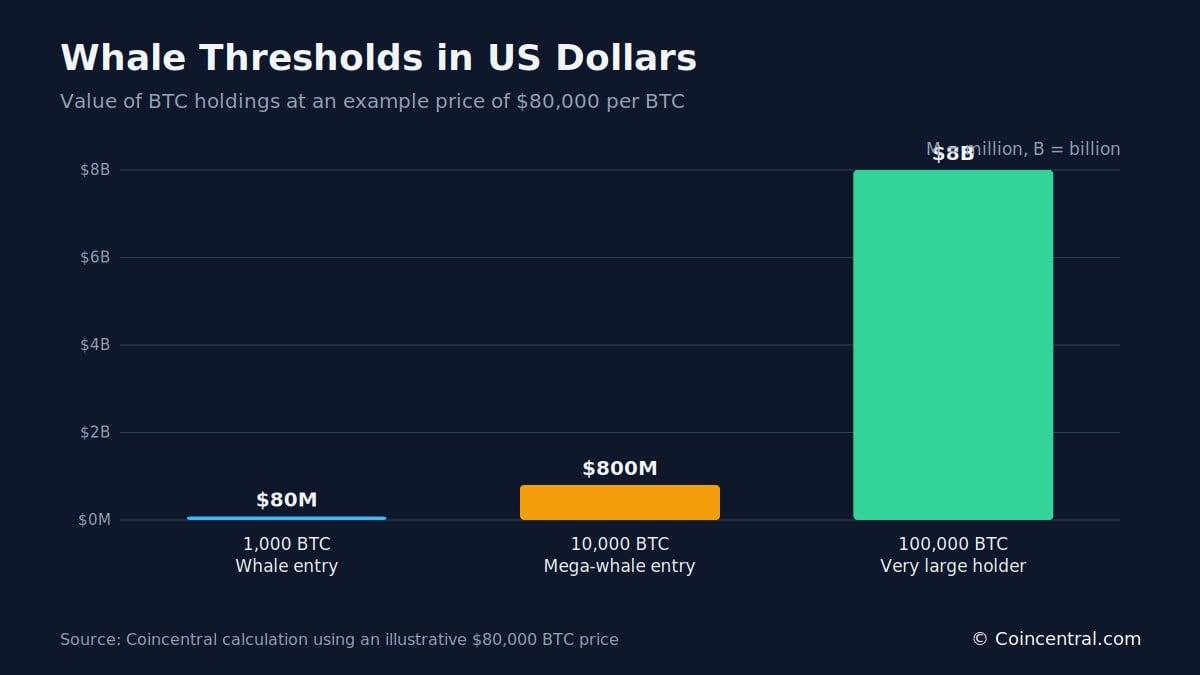
The table below shows what those balances are worth at an example price of $80,000 per BTC. The price is for illustration and is not a forecast.
| Holding | BTC | Value at $80,000 |
|---|---|---|
| Whale entry level | 1,000 BTC | $80 million |
| Mega-whale entry level | 10,000 BTC | $800 million |
| Very large holder | 100,000 BTC | $8 billion |
Large addresses do not always belong to wealthy individuals. They can belong to exchanges, ETF custodians, investment funds, governments, mining companies, corporations, market makers and custody providers.
Glassnode warns that its whale statistics include exchanges, custodians and ETF products. It also notes that one entity may split or combine funds across many addresses.
A social media post saying “10,000 BTC moved by a whale” does not prove that one billionaire is about to sell.
How Much Bitcoin Do Large Wallets Hold?
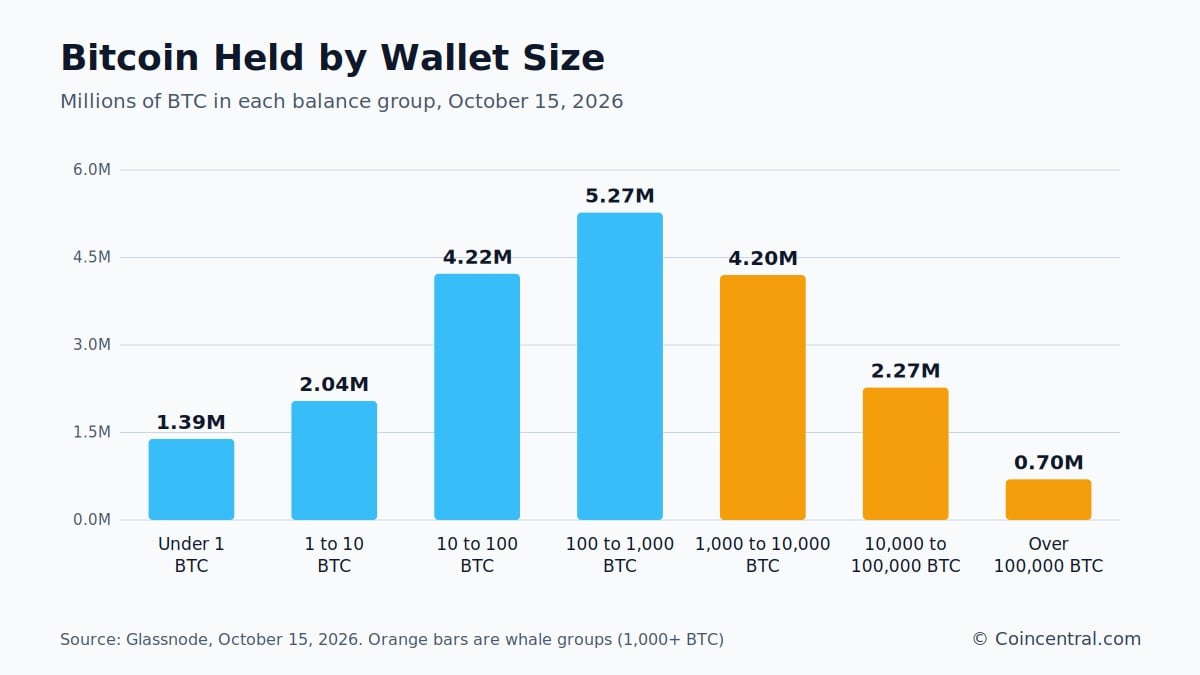
Glassnode’s wallet-size data for October 15, 2026 shows how supply is spread across balance groups. Total supply in the dataset was about 20.10 million BTC.
| Bitcoin balance | BTC held |
|---|---|
| Under 1 BTC | 1.39 million |
| 1 to 10 BTC | 2.04 million |
| 10 to 100 BTC | 4.22 million |
| 100 to 1,000 BTC | 5.27 million |
| 1,000 to 10,000 BTC | 4.20 million |
| 10,000 to 100,000 BTC | 2.27 million |
| More than 100,000 BTC | 697,000 |
Wallets holding 100 to 1,000 BTC held the most, at 5.27 million BTC. Wallets holding 10 to 100 BTC came next with 4.22 million BTC.
Wallets under 1 BTC held 1.39 million BTC in total. Wallets with more than 100,000 BTC held 697,000 BTC.
These are wallet balances, not owners. An exchange wallet holding 100,000 BTC could represent the assets of hundreds of thousands of customers.
The figures still explain why analysts track large holders. They show where supply is concentrated, even if they cannot show who is behind each address.
Share of Bitcoin Supply Held by Whale Addresses
Addresses holding at least 1,000 BTC contained about 7.18 million BTC. That is roughly 35.7% of the supply in the dataset.
The other 64.3% sat in addresses holding less than 1,000 BTC. Within the whale groups, the 1,000 to 10,000 BTC range held the most.
| Address group | BTC held | Share of supply |
|---|---|---|
| Under 1,000 BTC | 12.92 million | 64.3% |
| 1,000 to 10,000 BTC | 4.20 million | 20.9% |
| 10,000 to 100,000 BTC | 2.27 million | 11.3% |
| More than 100,000 BTC | 697,000 | 3.5% |
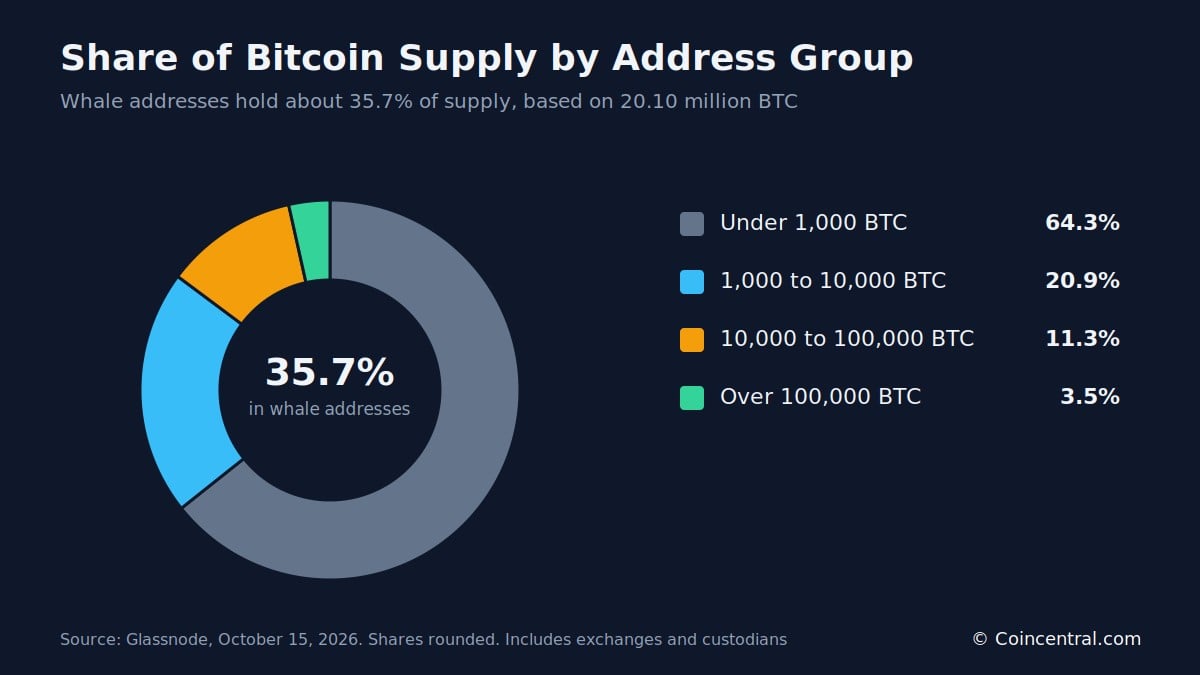
Shares were calculated by dividing each group by the 20.10 million BTC total and rounding. Small differences from the headline figure come from rounding.
Again, this is wallet concentration and not beneficial ownership. A single custody provider can show up as a very large address while serving many clients.
How Large Trades Move Prices
The simplest form of whale influence is market impact, and it is not manipulation. Market capitalization is price multiplied by supply. It does not equal the cash available to buy.
Take a token with a $5 billion market cap. Its order books might hold only $10 million of realistic liquidity near the current price.
If a whale places a $20 million market sell order, buyers at the current price run out quickly. The order then fills against lower and lower bids.
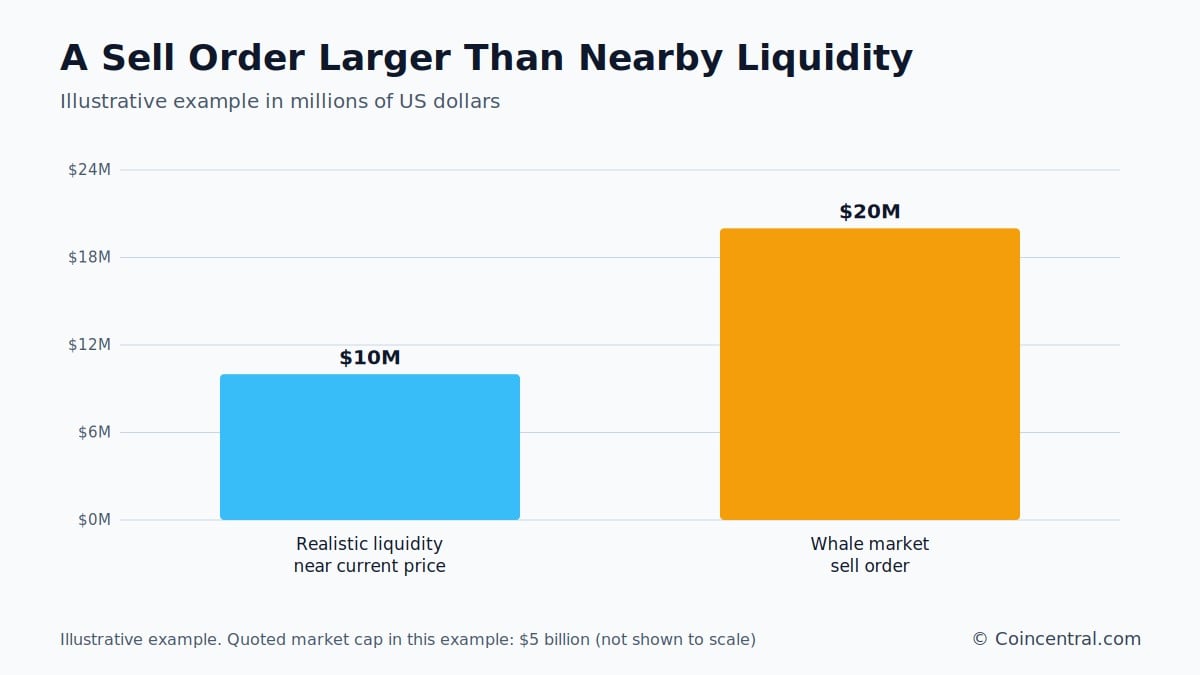
The displayed price falls. Other traders see the drop and start selling, and stop-loss orders trigger.
A $20 million sale can erase hundreds of millions of dollars from quoted market cap. A holder does not need to sell 10% of a token’s value to cut its valuation by 10%.
The Bank for International Settlements calls this the “crypto multiplier.” One dollar entering or leaving a coin can change its market cap by more than one dollar. The reason is that only a small share of supply trades at any moment.
Bitcoin Versus Small Tokens
A June 2026 CFTC filing on Bitcoin market structure argued that manipulating Bitcoin is harder than manipulating smaller coins. It pointed to a larger market, better liquidity and trading spread across regulated venues.
Bitcoin trades on spot exchanges, CME futures, perpetual futures, options, OTC desks and ETFs. If the price falls on one venue, arbitrage traders buy there and sell elsewhere, which pulls prices back together.
Large orders can still move Bitcoin. The capital needed is simply far greater than for a token with $500,000 of liquidity on its main venue.
Leverage, Liquidations and Quiet Accumulation
Leverage can magnify a whale’s trade. Suppose Bitcoin falls after a large holder starts selling.
Leveraged long positions begin to reach their liquidation prices. Exchanges close those positions automatically, which adds forced selling and pushes prices lower.
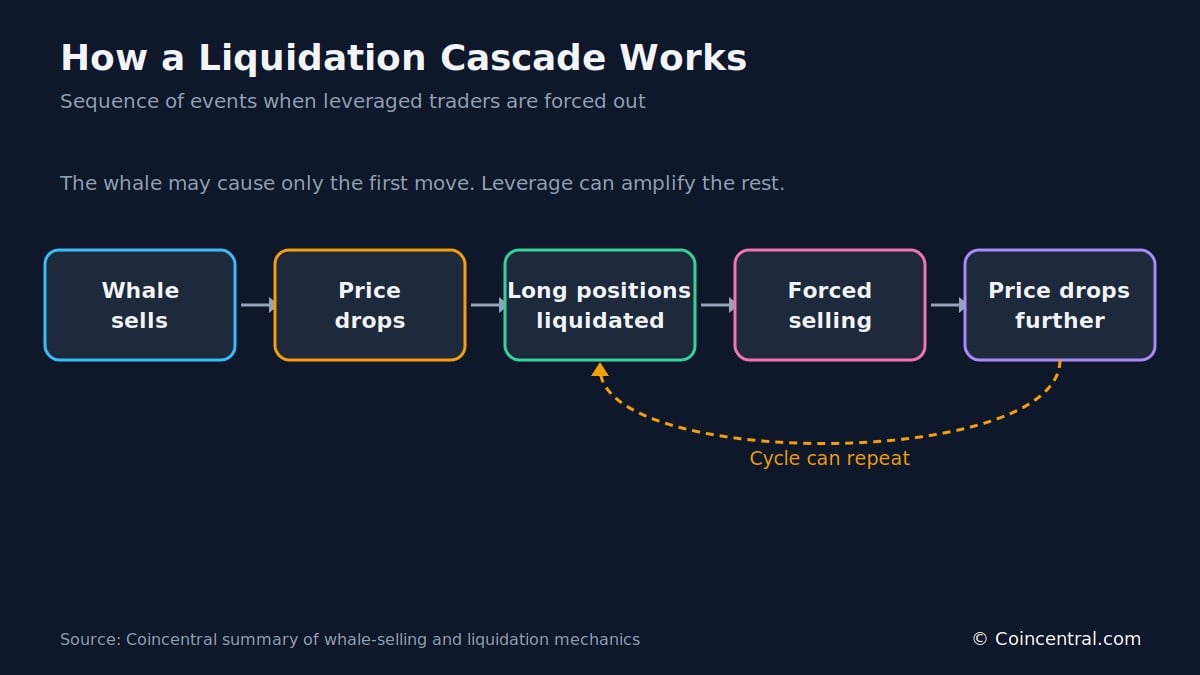
The whale may cause only the first move. The derivatives market can amplify everything after it.
A big drop therefore does not prove that a whale sold a large share of supply. Liquidity and leverage often matter more than headline market cap.
The same process can run upward. A large purchase can push price through resistance, force short sellers to buy back positions and trigger a short squeeze.
Buying Without Moving the Price
Large buyers face the opposite problem. Buying $100 million of a coin all at once could push the price sharply higher and make later purchases more costly.
Institutions often use legitimate methods to limit market impact. They may spread orders over time or trade through OTC desks instead of public order books.
If whales move coins from exchanges into long-term custody, fewer coins remain available to sell. That can make prices more sensitive when demand rises.
Analysts follow whale balances, exchange deposits and withdrawals, long-term holder supply and realized profit. These metrics add context, but none proves what a particular whale plans to do.
Pump-and-Dump Statistics
A pump-and-dump is a true manipulation technique. The CFTC describes the pattern as people accumulating or controlling a little-known token and promoting it hard.
Outside traders then push the price higher. The promoters sell their holdings before other participants can exit.
The method works best in small tokens. Imagine insiders hold 30% of a token’s supply, genuine liquidity is $2 million and the nominal market cap is $100 million.
The insiders might promote the token through social media, Telegram or Discord groups, influencers, false announcements or misleading partnership claims. Retail buyers arrive and the price rises.
The insiders then sell into that demand. Once selling overwhelms available liquidity, the price can collapse and late buyers are left with falling tokens.
What Chainalysis Found for 2024
Chainalysis analyzed more than 2.06 million tokens launched during 2024. Around 873,957 of them reached a decentralized exchange.
Using a deliberately restrictive set of indicators, it flagged 74,037 tokens with patterns that may fit pump-and-dump activity. That is about 3.59% of all tokens launched that year.
| Measure | 2024 figure |
|---|---|
| Tokens launched | More than 2.06 million |
| Tokens that reached a DEX | 873,957 |
| Tokens flagged for possible pump-and-dump patterns | 74,037 |
| Flagged share of all launches | 3.59% |
| Flagged pools dumped by the same actor that deployed them | About 94% |
| Average length of a suspected scheme | 6.23 days |
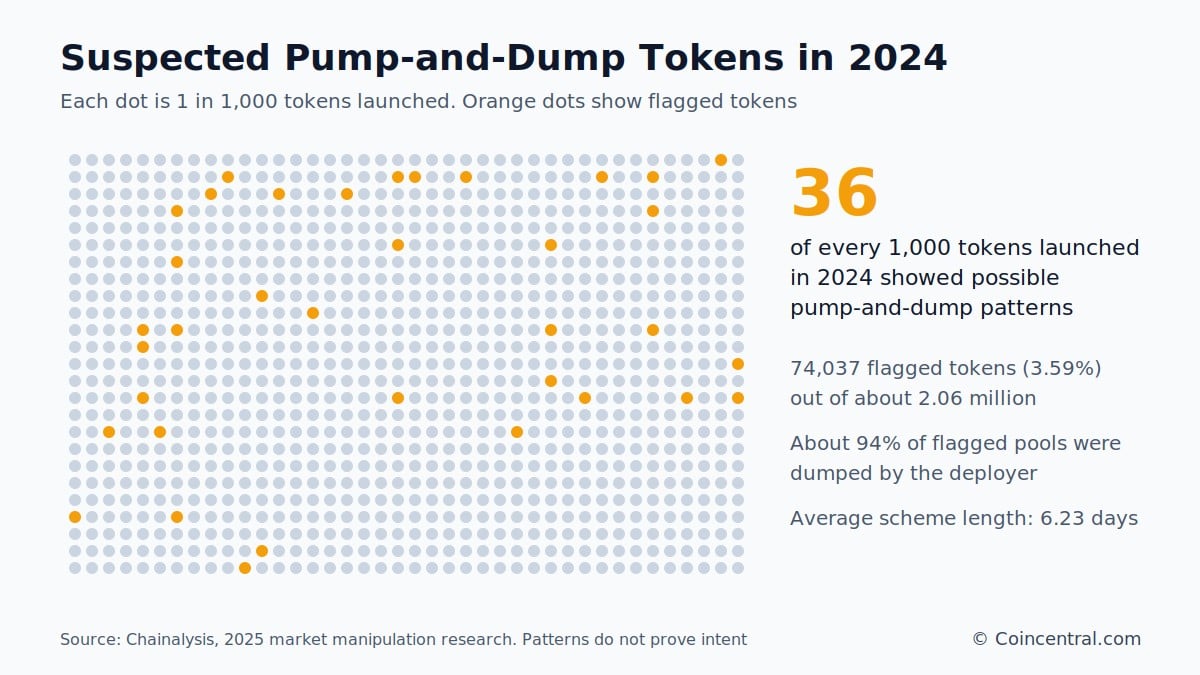
These are behavior patterns and not legal findings. Chainalysis cautions that on-chain data alone cannot establish intent.
Even so, the scale shows how easily low-liquidity tokens can be targeted.
Liquidity Removal and Rug Pulls
Many small tokens trade against liquidity pools on decentralized exchanges. If the creator or another large holder controls much of a pool, that liquidity can sometimes be withdrawn.
Holders may then find they cannot sell near the displayed price. This is often called a rug pull.
Chainalysis examined cases where liquidity providers removed at least 65% of a token’s pool after heavy activity. A quoted price means little when the liquidity behind it is tiny.
Wash Trading Statistics
Wash trading means buying and selling an asset in ways that create trading activity without a real change in ownership. The goal can be to make a token look more liquid, popular or valuable.
Imagine a token that truly trades $50,000 per day. Artificial trades push its displayed volume to $5 million, which is 100 times higher.
An investor may conclude the token has plenty of liquidity. In fact, much of the volume may not come from independent buyers and sellers.
Suspected Volume Reached Billions
Chainalysis built two methods to detect suspicious activity on Ethereum, BNB Smart Chain and Base during 2024. The first found about $704 million of possible wash-trading volume.
The second found about $1.87 billion. Added together, they give an upper-bound estimate of $2.57 billion.
| Measure | Estimate |
|---|---|
| Method 1 | $704 million |
| Method 2 | $1.87 billion |
| Combined upper bound | $2.57 billion |
| Largest single operator under one method | $313.6 million |
| Share of active DEX pools showing the pattern each month (one method) | 0.2% to 0.3% |
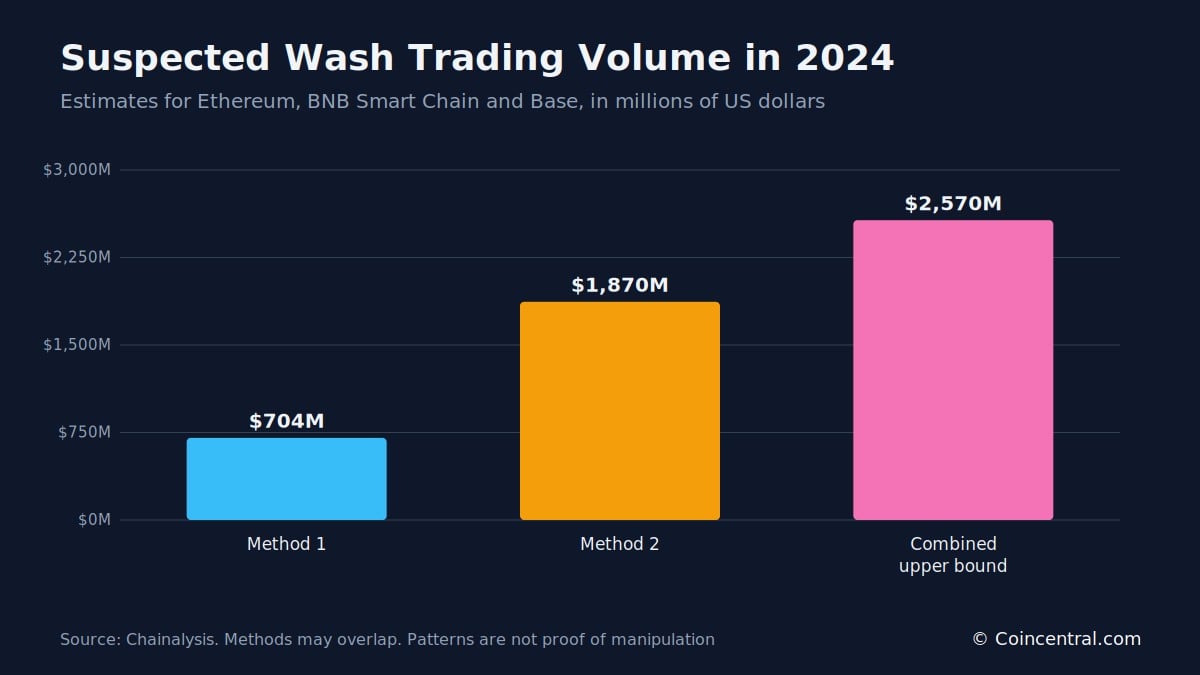
Chainalysis warns that the datasets may overlap and that suspicious patterns are not proof of manipulation. The activity was also concentrated in a small share of pools.
The lesson is that trading volume should never be the only reason to trust a small cryptocurrency.
Regulator Actions on Artificial Volume
In October 2024, the SEC charged three so-called market makers and nine individuals. It alleged schemes meant to create a false appearance of active crypto trading.
The SEC said firms including ZM Quant and Gotbit provided what amounted to market manipulation as a service. They allegedly generated artificial volume for crypto promoters.
The case kept developing. In March 2026, the U.S. Department of Justice announced charges against ten executives and employees linked to Gotbit, Vortex, Antier and Contrarian.
Prosecutors alleged that the firms inflated both prices and volumes before participants sold tokens to unsuspecting investors.
| Date | Agency | Charged | Allegation |
|---|---|---|---|
| October 2024 | SEC | 3 market makers and 9 individuals | False appearance of active trading |
| March 2026 | DOJ | 10 executives and employees | Inflated prices and volumes, then sales to investors |
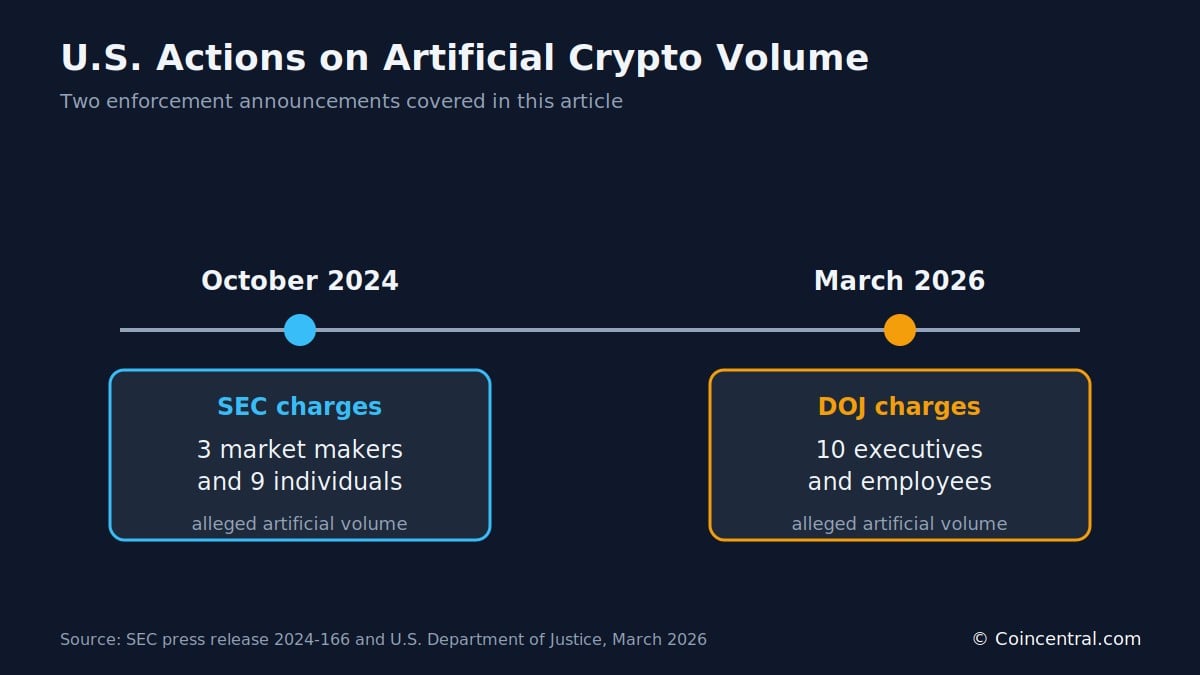
These cases show that manipulation does not always involve one mysterious billionaire. It can involve token developers, market makers and groups of coordinated wallets.
Spoofing and Order-Book Walls
Spoofing means placing orders to create a misleading picture of supply or demand, without real intent to trade. An order book may suddenly show huge selling pressure, and other traders react to it.
If the orders were meant to deceive and were pulled before they filled, the signal was false. SEC disclosures on digital assets list spoofing, wash trading, front-running and pump-and-dump activity among manipulation risks.
A large “buy wall” or “sell wall” should not be treated as permanent support or resistance. Orders can disappear.
Token Ownership Concentration
Bitcoin is spread out more widely than many other cryptocurrencies. A newly created token can look very different.
Consider a token split this way: team 20%, early investors 25%, treasury 20%, market makers 10% and public circulation 25%. Three or four groups may then influence most of the supply.
| Holder group | Share of supply |
|---|---|
| Team | 20% |
| Early investors | 25% |
| Treasury | 20% |
| Market makers | 10% |
| Public circulation | 25% |
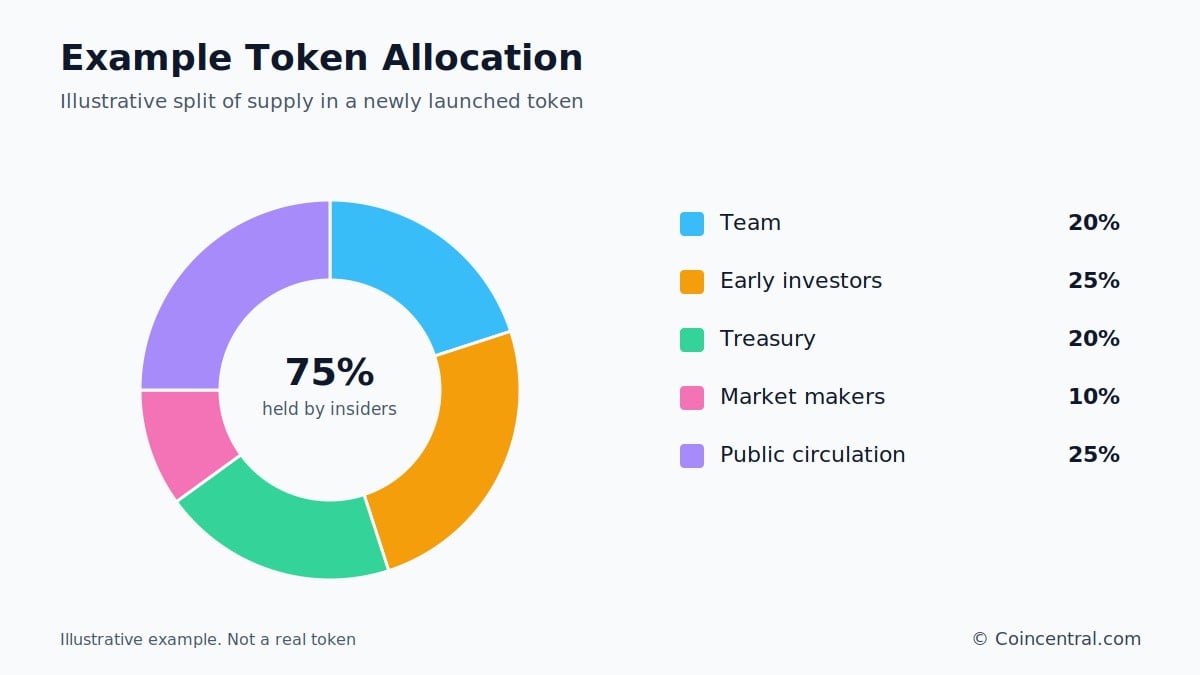
If only part of the 25% public share is actually liquid, insiders can have a large effect on price. A $1 billion market cap can sit on very little liquid capital.
Investors should look at circulating supply and not just maximum supply. They should also check team allocations, venture capital ownership, treasury wallets, vesting schedules, token unlocks and largest-holder percentages.
Whale Alerts, Wallet Moves and Retail Behavior
Blockchain data is public, so anyone can watch large transfers. Alert services post messages such as “2,000 BTC transferred to Binance.”
Traders often read that as bearish, since coins on an exchange can be sold. There are many other explanations.
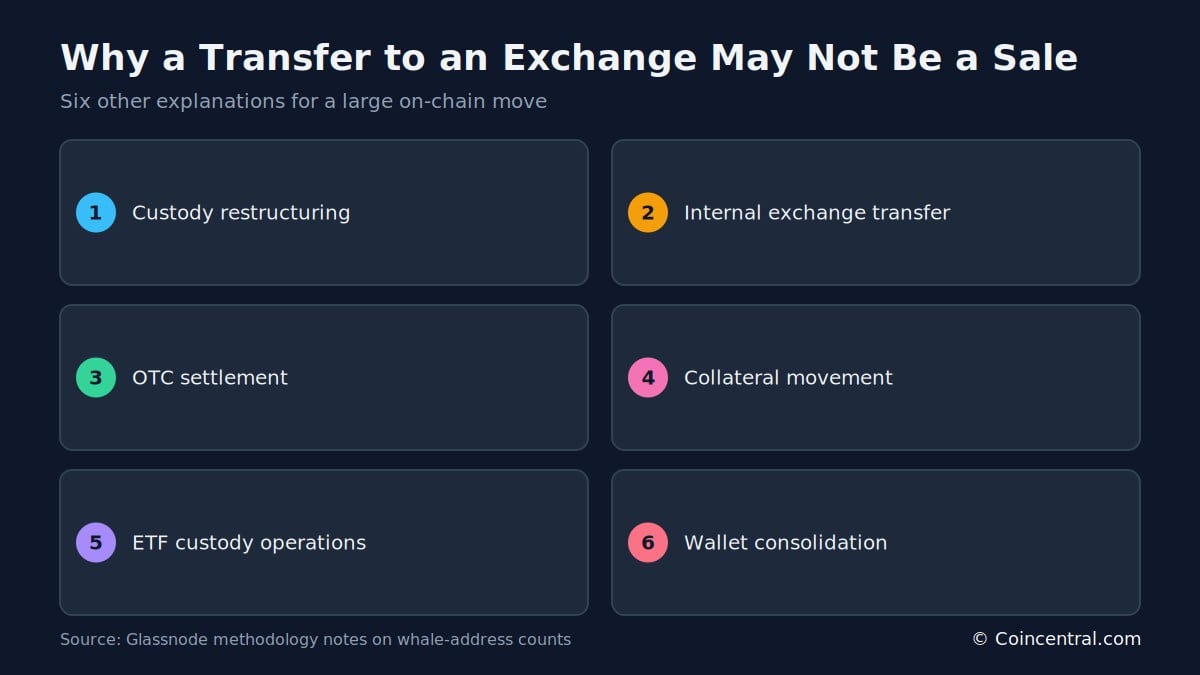
Glassnode cautions that changes in whale-address counts can come from exchange wallet reshuffling, custody migration or ETF flows. They do not always reflect a change in investor behavior.
A whale does not need to sell for others to react. The expectation of selling can move the market, which makes whale alerts useful but easy to misread.
Retail Buying and Large-Holder Behavior
BIS research compared small Bitcoin holders with large holders. Retail balances tended to rise when the market rose, while some large-holder groups moved the other way.
In its sample, a 1% rise in Bitcoin’s price was linked to higher holdings among small investors and lower balances among the large miner group studied.
Taking profit after a rally is legitimate. But promoters can use this habit by building hype just when they want outside buyers to provide exit liquidity.
Warning Signs and Investor Protection
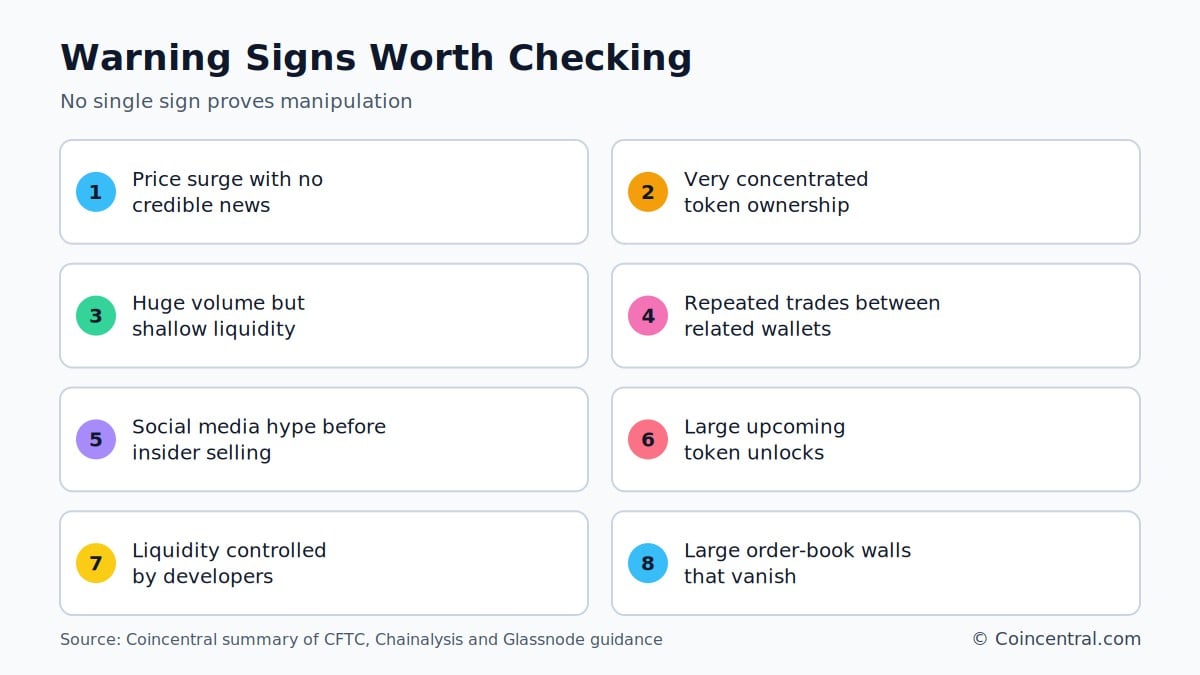
No indicator proves manipulation on its own. Chainalysis repeatedly warns against calling suspicious blockchain patterns manipulation without more evidence, because intent is hard to see in transactions alone.
Attribution is also difficult. Ten addresses do not always mean ten people, and one exchange wallet can hold assets for millions of users.
Still, several warning signs deserve attention. The chart below lists eight of them. Other signs include unusual volume that differs across exchanges and large transfers right before odd price moves.
The CFTC advises investors not to buy obscure tokens because of social media tips. It warns that pump-and-dump organizers usually sell before their followers can get out.
- Avoid chasing steep price jumps.
- Check token-holder concentration before investing.
- Look at real liquidity and not only market cap.
- Be wary of sudden volume spikes.
- Avoid heavy leverage.
- Review token-unlock schedules.
- Be careful with newly launched micro-cap tokens.
A market can also fall sharply without any manipulation. Crypto is volatile even when everyone trades honestly.
The Bottom Line
Crypto whales can have large market influence, but influence and manipulation are different things. A big holder can move a price just by trading into limited liquidity.
The risks grow in small, illiquid coins with concentrated ownership. Chainalysis found up to $2.57 billion of possible wash trading in 2024 and 74,037 tokens with possible pump-and-dump patterns, while stressing that these patterns do not prove intent.
Regulators have acted as well. The SEC charged crypto market makers and promoters in 2024, and U.S. prosecutors charged ten more people in March 2026.
Bitcoin remains exposed to whale-driven swings. Its size and liquidity make sustained manipulation much harder than in a thinly traded token.
For most investors, the main risk is not a hidden billionaire controlling the market. It is a small, concentrated market where a few insiders hold enough supply to overwhelm everyone else.
Sources
- Chainalysis, Crypto Market Manipulation: Suspected Wash Trading and Pump-and-Dump Schemes
- Bank for International Settlements, The Crypto Multiplier
- Bank for International Settlements, Crypto Trading and Bitcoin Prices
- Glassnode, Bitcoin Supply by Wallet Size
- Glassnode, Bitcoin Whale Address Count
- U.S. Securities and Exchange Commission, Crypto Market Maker Manipulation Charges
- U.S. Department of Justice, Ten Foreign Nationals Charged in Cryptocurrency Market Manipulation Operation
- Commodity Futures Trading Commission, Digital Asset Frauds
- CFTC, Beware Virtual Currency Pump-and-Dump Schemes