


GnuVPN is a privacy VPN that does two things most rivals do not: it takes your money in crypto, and it gets you online where VPNs are blocked.
Pay in USDT (TRC20), Bitcoin, or Litecoin, and your subscription never has to touch a bank card. Connect through SoftEther, and your traffic slips past firewalls that shut other VPNs out. That combination is rare, and it is the reason GnuVPN stands apart from the household names.
A Google MASA Level 2 review on its Android app and an automatic kill switch round out the case.
Here is how it holds up.
What Is GnuVPN? A Protocol-First VPN Explained
GnuVPN is a privacy VPN that encrypts your connection, hides your IP address, and accepts cryptocurrency for payment. It is run by GNUAPP UNIPESSOAL LDA, a company registered in Portugal, which places it under GDPR, one of the stricter privacy regimes.
The service leans on protocol flexibility. It offers a wider spread of connection protocols than most rivals, with SoftEther as the headline feature, and it keeps payment private through crypto.
That focus shapes who it suits. GnuVPN works best for people who want private payment, need a connection that holds up on restrictive networks, or want strong protocol choice in one app.
Apps cover Windows, macOS, iOS, Android, and Linux, with support for up to five devices on one subscription. It is also one of the few VPNs on the Huawei AppGallery and Xiaomi GetApps, not just Google Play and the App Store. Here is the short version:
| Feature | Detail |
| Operator | GNUAPP UNIPESSOAL LDA (Portugal) |
| Payments | Crypto (USDT-TRC20, TRON, BTC, LTC), cards, PayPal |
| Protocols | SoftEther, AmneziaWG, WireGuard, OpenVPN, IKEv2 |
| Servers | 55+ countries |
| Devices | 5 simultaneous |
| Available on | Google Play, App Store, Huawei AppGallery, Xiaomi GetApps |
| Certification | Google MASA Level 2 (Android app) |
How Can You Pay for GnuVPN With Crypto?
Crypto payment is where GnuVPN pulls ahead of most rivals. Plenty of VPNs take Bitcoin and stop there. As a VPN that accepts crypto more broadly, GnuVPN takes USDT (TRC20), TRON, Bitcoin, and Litecoin, so you can pay with the coins you actually hold.
USDT (TRC20) is the standout. It settles fast and carries low fees, which makes paying for a VPN with USDT a practical option, not just a token gesture toward crypto users.
For anyone who would rather not tie a VPN to a bank card, that flexibility matters. It keeps your payment separate from your identity, and the site walks you through the process with step-by-step guides for paying through Binance.
GnuVPN pricing is simple, and the long plans bring the monthly cost down:
- 2-year: $2.79/month, billed as $66.99 upfront
- 1-year: $3.49/month, billed as $41.99 upfront
- 6-month: ~$4.50/month, billed as $26.99 upfront
- 1-month: $13.99, billed monthly
GnuVPN also runs a referral program. Invite friends, and you earn 10% to 30% of what they spend as points, worth one cent each, which you can put toward renewals. Points transfer between accounts, and you do not need an active subscription to start earning.
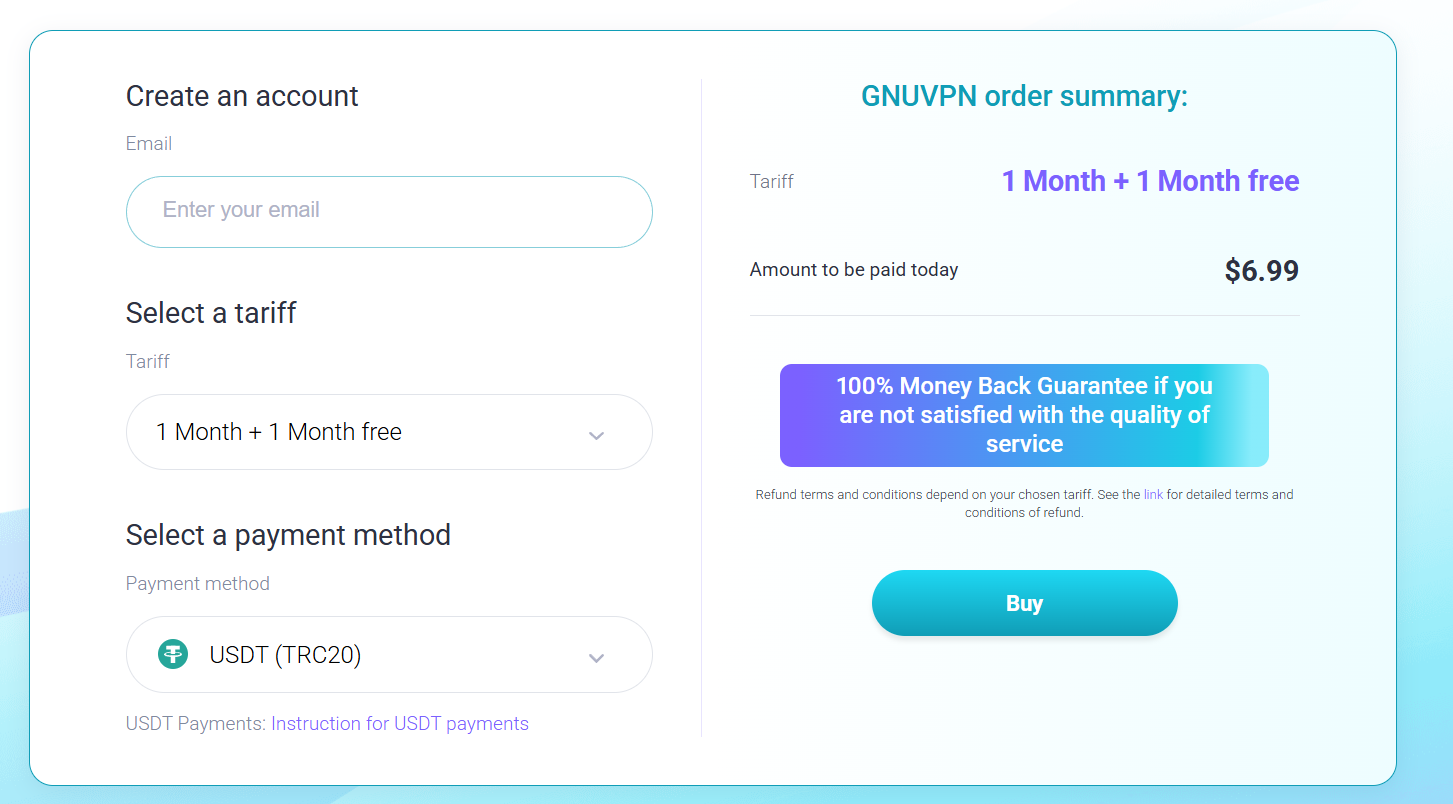
GnuVPN checkout page for VPN subscriptions. Source: GnuVPN
What Protocols Does GnuVPN Use?
GnuVPN offers five protocols, two of which almost no mainstream rival carries:
- SoftEther: disguises VPN traffic as ordinary HTTPS, so firewalls watching for VPNs see routine web browsing. A SoftEther VPN gets through school, office, and national filters that block other protocols, and this is GnuVPN’s standout.
- AmneziaWG: a modified WireGuard that scrambles its traffic shape to dodge detection, keeping WireGuard’s speed while adding disguise. The lighter option when a network still needs some obfuscation.
- WireGuard: the fast, modern default for everyday browsing, streaming, and general use.
- OpenVPN: the long-trusted standard, valued for broad compatibility and reliability.
- IKEv2: the mobile-friendly choice that holds steady when you switch between Wi-Fi and data.
Is GnuVPN Safe? Security and Privacy Analysis
GnuVPN’s security holds up well for a service its size, and it has one credential most small VPNs lack. Its Android app carries Google’s MASA Level 2 certification, an independent security review by an authorised lab under Google’s App Defense Alliance.
MASA checks the app itself, including how it handles encryption, permissions, and data. It is a real, independent tick that most rivals never obtain.
On privacy, GnuVPN states that it does not collect browsing history, traffic content, or DNS queries, and does not keep connection logs such as assigned IP addresses or session times. Its Portuguese base places it under GDPR, which sets a high bar for how it handles user data.
The apps also ship with a kill switch. If the connection drops, it blocks internet traffic so your real IP does not leak while you reconnect.
User feedback backs this up. GnuVPN holds a 4.5-star rating across roughly 21,400 reviews on Google Play, which points to a stable experience for the bulk of its users.
Servers, Speed and Platforms
GnuVPN runs servers in 55+ countries and adds new locations regularly, across Europe, the Americas, and Asia. The network is smaller than the household names, but it covers the major regions most users connect through.
Speed is solid on nearby servers, where WireGuard and AmneziaWG keep overhead low. As with any VPN, expect some drop on servers farther away, though everyday browsing and streaming hold up well.
Platform support is one of GnuVPN’s quiet strengths. It covers desktop and mobile, and reaches app stores that many rivals skip:
- Desktop: Windows (including older versions), macOS, and Linux (Ubuntu and Debian)
- Mobile: iOS and Android
- App stores: Google Play, Apple App Store, Huawei AppGallery, and Xiaomi GetApps
One subscription covers five devices at once, enough for most households to run phones, laptops, and a tablet together.
Does GnuVPN Work for Gaming?
GnuVPN markets itself to gamers, and the honest picture is that it helps in specific ways and does not simply lower your ping. What it does well is protect and stabilise the connection around your play.
The clearest benefit is protection. A VPN hides your real IP address, which shields you from DDoS attacks during ranked play and online tournaments. For esports players, that alone can be reason enough.
It also helps you get around ISP throttling, and the server network lets you reach games and cloud gaming platforms in other regions, whether that is an earlier release, a different matchmaking pool, or a title tied to another country.
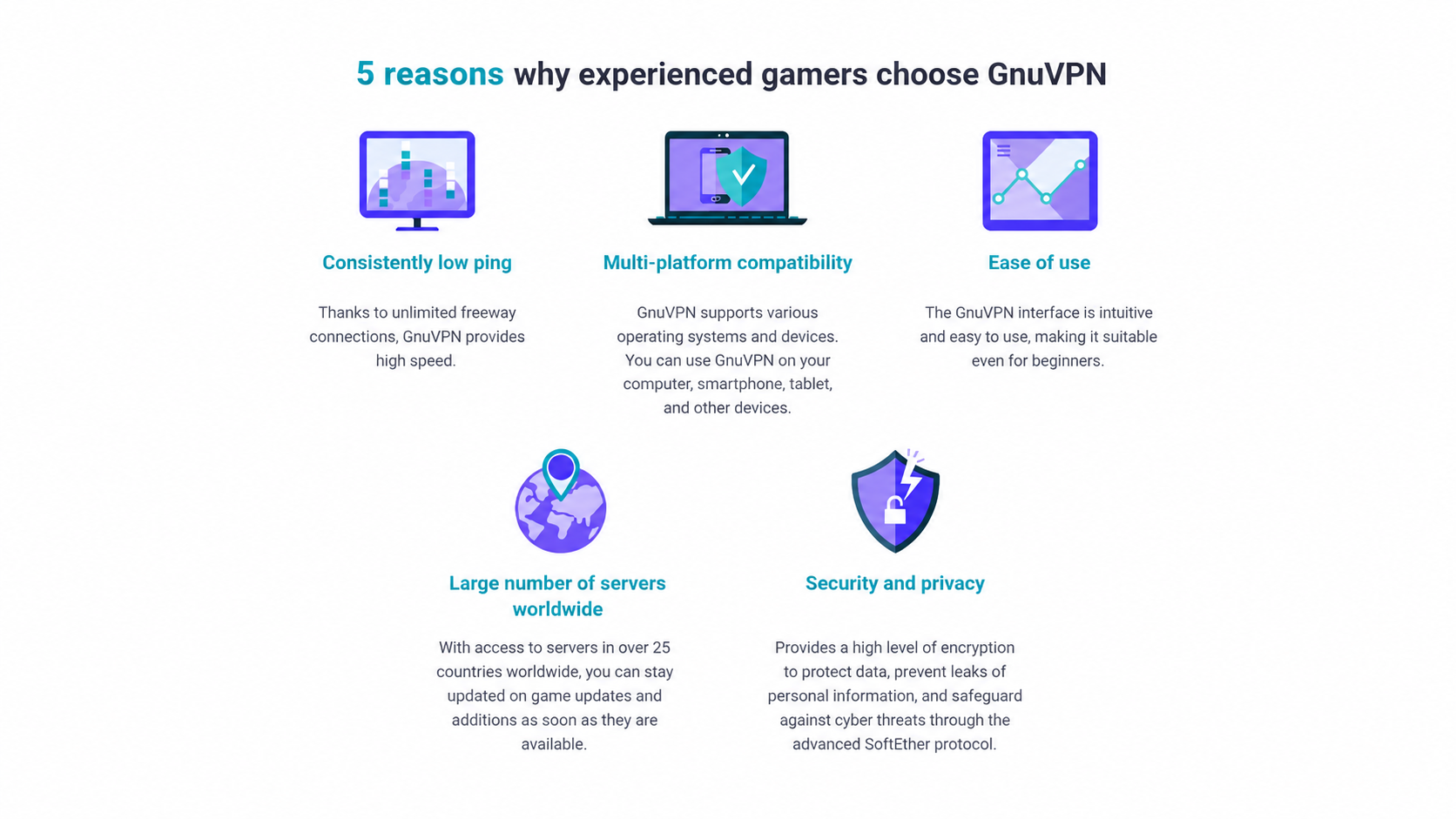
GnuVPN’s key features include low latency, multi-platform compatibility, global server coverage, and privacy-focused security. Source: GnuVPN
GnuVPN Pros and Cons
Every VPN involves trade-offs. Here is where GnuVPN lands after testing its features, protocols, and pricing.
Pros
- Crypto payments: USDT-TRC20, TRON, Bitcoin, and Litecoin, with Binance guides
- SoftEther and AmneziaWG: two obfuscation protocols almost no mainstream rival offers
- Google MASA Level 2: an independent security review of the Android app
- Automatic kill switch: blocks traffic if the connection drops, so your real IP never leaks
- Gaming protection: hides your IP against DDoS and helps bypass ISP throttling
- Wide platform reach: Windows, macOS, Linux, iOS, and Android
- On Huawei AppGallery and Xiaomi GetApps: available where most major VPNs are not
- GDPR coverage: a Portuguese base under one of the stricter privacy regimes
Cons
- Smaller server network than the household names, at 55+ countries
- Five device limit, where some rivals offer more
- SoftEther is strongest on Android, so protocol choice varies by platform
Who Should Use GnuVPN?
GnuVPN is not built to be all things to all people, and that focus makes it an easy call for some users.
It is a strong choice if you value private payment. If you would rather pay in USDT, TRON, Bitcoin, or Litecoin than hand over a card, few VPNs make that as easy.
It also suits anyone who connects through networks that block VPNs. Students on campus Wi-Fi, employees behind corporate firewalls, and travellers in filtered regions benefit directly from SoftEther and AmneziaWG. Gamers get real value too, through IP protection against DDoS and access to servers in other regions.
It is less of a fit if your main priority is a vast server network or a high device count. The household names still lead on raw scale. For the right user, though, GnuVPN offers something they do not: private payment and a connection that keeps working where others get blocked.
Verdict: Is GnuVPN Worth It?
GnuVPN knows exactly what it is. It focuses on private payment and protocol flexibility, and it delivers both better than most services its size.
For crypto users, the appeal is direct: pay in USDT, TRON, Bitcoin, or Litecoin, keep your identity separate from your subscription, and get a MASA-reviewed app with a kill switch on top.
For anyone on a restrictive network, SoftEther and AmneziaWG are genuine tools, not marketing lines. At $2.79 per month, the package holds together well.
It will not suit everyone. If you want the largest server network or a high device count, the household names still lead. But for private payment, privacy on restrictive networks, and protected play, GnuVPN offers something genuinely its own.
FAQ
Can I pay for GnuVPN anonymously with cryptocurrency?
You can pay in USDT (TRC20), TRON, Bitcoin, or Litecoin, which keeps your subscription separate from a bank card or PayPal account. That adds a layer of separation between your identity and your VPN use. GnuVPN provides step-by-step guides for paying through Binance if you are new to crypto payments.
Does GnuVPN work in China or other countries with heavy censorship?
SoftEther is built for exactly this. It disguises VPN traffic as ordinary HTTPS, which helps it get through national firewalls that block standard protocols. No VPN can promise permanent access, since filters change constantly, but GnuVPN’s obfuscation protocols give it a better chance than services relying on WireGuard or OpenVPN alone.
Why pay for a VPN with USDT instead of Bitcoin?
USDT (TRC20) settles quickly and carries low transaction fees, which makes it practical for a recurring subscription. It is also a stablecoin, so its value does not swing between the moment you pay and the moment it clears. GnuVPN accepts both, so the choice is yours.
How many devices can I use with one GnuVPN subscription?
One subscription covers five devices at the same time, across Windows, macOS, Linux, iOS, and Android. That is enough for most people to protect a laptop, a phone, and a tablet together, or to share a plan across a small household.
Can I use GnuVPN on Huawei devices without Google services?
Yes. GnuVPN publishes directly to the Huawei AppGallery and Xiaomi GetApps, so you can install it on devices that lack Google Play. Most major VPNs skip these stores entirely, which makes GnuVPN a practical option for Huawei and Xiaomi users.
Disclaimer: This article is provided for informational purposes only. It is not offered or intended to be used as legal, tax, investment, financial, or other advice.
Disclaimer: This is a Press Release provided by a third party who is responsible for the content. Please conduct your own research before taking any action based on the content.

