




TLDR
- The KOSPI fell as much as 5.8% on Monday, a day after the government promised help.
- Seoul has a 10 trillion won fund ready but has not bought any shares.
- Companies get more room to buy back their own stock for three months.
- Samsung Electronics and SK Hynix fell as AI spending worries spread.
- Foreign investors have pulled $115.2 billion from Korean stocks.
South Korean stocks fell hard again on Monday, even after leaders promised to help. The KOSPI dropped as much as 5.8% to 4,586.80 during the session. South Korea is Asia’s fourth-largest economy.
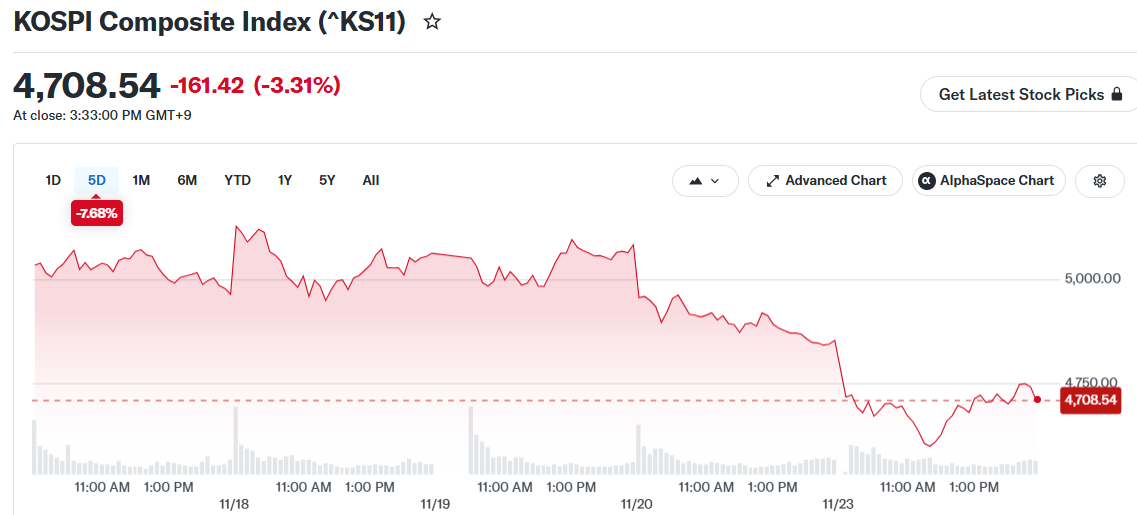
That followed a 5.21% loss on Friday, which left the index at a 10-month closing low. At Monday’s low, it sat about 21% below its November 2 close.
Finance Minister Lee Hyoung-il spoke to reporters in Sejong on Monday. He said officials would decide whether to act based on market conditions.
What Seoul Has Done So Far
A government meeting on Sunday produced a plan to use a market stabilization fund if conditions worsened. Reports put the fund at 10 trillion won, or about $6.8 billion.
By Monday, no shares had been bought through the fund. Lee said officials have extra backup steps and will use them at the right time.
Listed companies will get more room to buy their own shares. Daily limits on buyback orders will be relaxed for three months starting Tuesday.
Regulators will also watch more closely for illegal short selling and market manipulation. They plan to track margin loans and possible forced selling as well.
Lee did not back new limits on short selling. He said the focus will be on enforcing the rules already in place.
South Korea ended a blanket short-selling ban in March 2025. The ban had run for 17 months, and a central detection system was set up afterward.
Chip Makers and Foreign Sellers Lead the Slide
Samsung Electronics fell between 5.5% and 6% on Monday. SK Hynix lost between 4.9% and 6%, and both firms carry heavy weight in the index.
Over the past month, Samsung is down about 20.1% and SK Hynix is down about 18.1%. Hyundai Motor fell 4.90% on Monday, and Kia lost 4.42%. Samsung Biologics dropped 5.61%.
Banks and insurers also fell. KB Financial Group lost 3.87%, and Shinhan Financial Group dropped 3.94%.
Investors are asking whether huge AI spending can deliver the profits that stock prices assume. Tighter US rules on access to advanced computing have added to the worry.
Foreign investors are on track for a seventh straight month of net selling. LSEG data show total outflows of $115.2 billion.
Korea-focused funds also fell hard in November. The Direxion Daily MSCI South Korea Bull 3X ETF lost 54.10% through November 20, while the iShares MSCI South Korea ETF fell 18.70%.
Chip-focused funds fell too, with the KICK Korea Semiconductor Index ETF down 26.90%. A defense-focused fund lost a smaller 13.51%.
Lee said growth could reach the upper-3% range if current trends hold. The International Monetary Fund forecasts growth of 3.9% this year and 3.3% in 2027. Consumer inflation is also expected to ease in 2027.
Lee also named AI regulation, geopolitical tension and higher global interest rates as risks. He said chip volatility could spill into the wider economy.
Kiwoom Securities analyst Han Jiyoung said the market needs a catalyst to bring foreign buyers back. The buyback changes begin Tuesday, and the stabilization fund has not yet made a purchase.