




TLDR
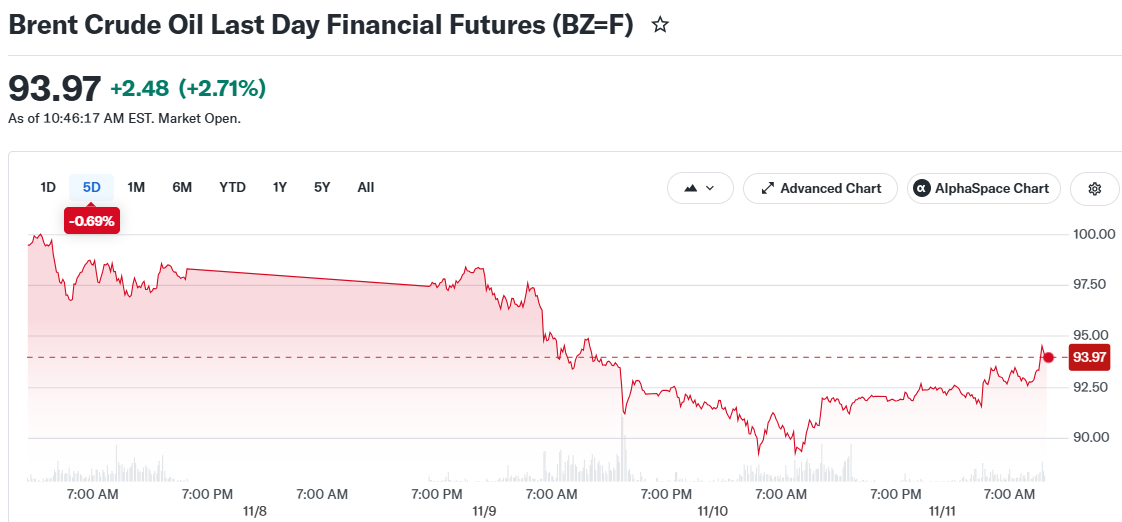
- Brent crude rose about 1.4% to $92.74 a barrel on Wednesday, while West Texas Intermediate gained about 1% to near $87.
- Oil had dipped below $90 on Tuesday for the first time since August.
- Tanker attacks near the Strait of Hormuz cooled hopes for a quick end to the U.S.-Iran conflict.
- Physical Brent fell to its weakest level against futures in about five months.
- The EIA expects U.S. crude stocks to climb to 444 million barrels by the end of 2027.
Oil prices rose on Wednesday after hitting a two-month low in the previous session. Brent crude futures gained about 1.4% to $92.74 a barrel. West Texas Intermediate futures rose between 0.7% and 1.1%, trading near $86.63 to $86.95.
On Tuesday, Brent briefly slid below $90 a barrel for the first time since August. Traders were weighing whether a Democrat-led U.S. Congress might push Washington to end the conflict with Iran. President Donald Trump has also signaled restraint this week, saying more military strikes were not needed for now.
Attacks near Hormuz test peace hopes
Iran has denied that peace talks are underway. Its top security chief said the country will not allow enriched uranium to be moved out of Iran. The U.S. has demanded that Tehran halt its nuclear ambitions.
Shipping in the Strait of Hormuz has also come under fire. The United Kingdom Maritime Trade Operations Centre said it received a report of an incident involving a tanker there on Wednesday. The condition of the crew, the extent of the damage and any environmental impact were not known.
The group had earlier reported that a tanker was hit by an unknown projectile northeast of Oman. Three tankers also reportedly caught fire in Hormuz over the weekend.
In recent days, the U.S. has struck Iran’s Qeshm Island, which houses Revolutionary Guard missile and drone sites. Tehran said on Tuesday that it targeted an Omani island used to help ships navigate the strait, The Wall Street Journal reported. U.S. and Gulf officials called the American strikes defensive and aimed at protecting commercial shipping.
Fighting has also continued between Saudi Arabia and Yemen’s Iran-backed Houthi rebels. The Houthis have targeted a key Saudi pipeline.
Even so, shipping data shows oil and gas moving through Hormuz at the highest level since the conflict began in February. This has helped ease some supply worries.
Supply signals point the other way
Analysts say the recent drop may have less room to run. Scott Shelton of TP ICAP said speculative long positions held by commodity trading advisers have largely been unwound. That could reduce the selling pressure on futures.
MUFG said the price decline may be hard to sustain without a lasting diplomatic deal. It also said shippers need more confidence that vessels can cross the waterway safely. The bank noted that an earlier agreement to reopen the strait held for only a few weeks before attacks resumed.
Physical oil markets show signs of extra supply in some regions. Physical Brent fell to its weakest level against futures in about five months, according to S&P Global Commodity Insights. High freight costs and cheaper Middle Eastern barrels have limited Asian demand for North Sea crude.
The physical Brent discount to futures reached $2.12 a barrel on Monday. Several North Sea cargoes remained without buyers.
Tanker freight rates have started to ease after months of disruption. Citing Morgan Stanley data, S&P Global Energy said 13 of 27 major tanker rates posted unusually large weekly drops in the week through Nov. 8. That pattern has been seen only once since 2021.
U.S. crude stocks rose by 9 million barrels in the latest week, Reuters reported, citing market sources. Official data is due later on Wednesday. ING analysts said uncertainty around the U.S.-Iran conflict continues to give prices some support.
The Energy Information Administration expects U.S. commercial crude stocks to rise from 416 million barrels at the end of January to 444 million barrels by the end of 2027.