

TLDR
- Volvo Cars expands its Nvidia partnership to advance automated driving technology.
- Nvidia’s Hyperion and Alpamayo platforms will power future Volvo driving systems.
- The automaker plans to introduce Nvidia technology across future vehicle models.
- Nvidia’s Alpamayo software surpasses 650,000 developer downloads worldwide.
- Volvo Cars targets its next-generation automated driving system before 2030.
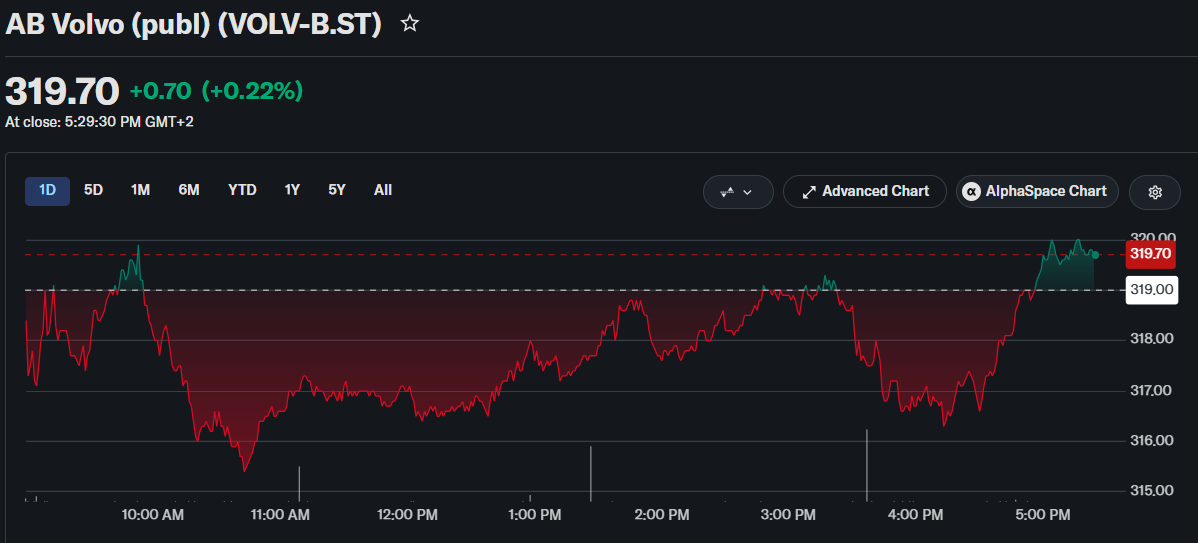
Volvo Cars announced an expanded Nvidia partnership on Thursday, October 15, to develop advanced automated driving technology for future vehicles. Separately listed AB Volvo (VOLV-B.ST) shares stood at SEK 319.70, gaining SEK 0.70, or 0.22%, according to supplied figures. The agreement combines Nvidia’s artificial intelligence platforms with Volvo Cars’ vehicle safety engineering to improve automated navigation.
Volvo Cars Expands Nvidia Partnership With Advanced AI Systems
Volvo Cars will integrate Nvidia’s Hyperion architecture, Alpamayo driving software, and Halos safety technology into its next-generation vehicles. Hyperion combines sensors and computing systems to help vehicles process surrounding traffic conditions and road information. Alpamayo provides artificial intelligence tools that support driving decisions across different road environments.
Nvidia developed Alpamayo as a collection of AI models, training datasets, simulation tools, and software development resources. The platform operates alongside conventional driving software that uses machine learning, cameras, and radar systems. This combined approach allows different technologies to process information simultaneously and support more reliable driving decisions.
Nvidia automotive division head Ali Kani explained that the company operates multiple software systems alongside different sensor technologies. The approach uses separate systems to assess road conditions and reduce dependence on individual software components. More than 650,000 developers have downloaded Nvidia’s open-source Alpamayo software, according to Kani.
Volvo Targets Automated Driving Across Future Vehicle Models
Volvo Cars plans to extend its automated driving technology beyond its existing battery-electric vehicle lineup. The company also intends to support plug-in hybrids and gasoline-powered vehicles through a broader software architecture. This expansion reflects its strategy of developing shared technology platforms across different vehicle categories.
Volvo Cars uses Nvidia’s Orin computing technology across its battery-electric vehicle range. These processors analyze information from cameras, radar, and other sensors to support driving assistance functions. The expanded partnership introduces additional computing capabilities and software components for more advanced automated driving features.
Volvo Cars software development head Alwin Bakkenes outlined the company’s shift toward developing integrated vehicle technology internally. The automaker previously relied on vehicle-specific development programs and multiple technology suppliers for different models. Now, its approach combines hardware, software, and safety engineering through a more unified development structure.
Nvidia Technology Supports Volvo Cars’ Long-Term Driving Strategy
Volvo Cars plans to introduce the upgraded Nvidia platform through a new vehicle before the decade ends. Management has not confirmed the model name, production schedule, or specific launch date. The company expects the initial deployment to support supervised automated driving, while drivers retain responsibility for vehicle operation.
The new system will use Nvidia’s Hyperion sensor and computing architecture to process information across different driving conditions. The Halos safety layer will support the evaluation of automated driving functions and system performance. These technologies will help the automaker develop software for increasingly complex road and traffic situations.
The partnership also supports Volvo Cars’ broader transition toward software-based vehicle development and shared technology platforms. Standardizing computing systems and sensors could simplify future integration across electric, hybrid, and conventional vehicles. The companies have not announced commercial revenue targets, implementation costs, or financial forecasts associated with the expanded agreement.
Get 3 Free Stock Ebooks
Discover top-performing stocks in AI, Crypto, and Technology with expert analysis.
- Top 10 AI Stocks - Leading AI companies
- Top 10 Crypto Stocks - Blockchain leaders
- Top 10 Tech Stocks - Tech giants