

Losing a crypto password is not the same as losing a bank password. A bank can reset your login. A self-custody wallet usually cannot.
This article looks at the numbers behind lost crypto wallets and seed phrases. It draws on five published guides and reports. Where the sources disagree, both figures are shown.
How Much Bitcoin Is Permanently Lost?
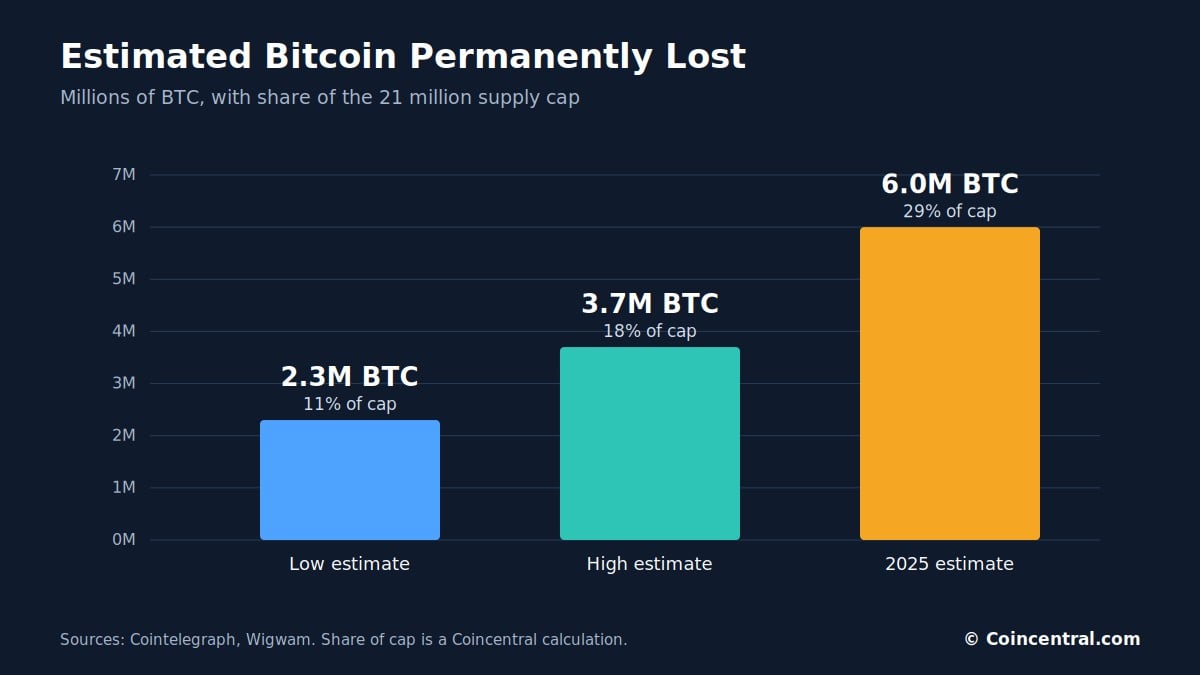
Estimates of lost Bitcoin vary by source and by year. Cointelegraph reports that, according to Ledger analysts, between 2.3 million and 3.7 million Bitcoin was permanently lost as of early 2025. Wigwam gives the same range and credits it to Chainalysis.
The sources do not agree on who produced the range. The numbers are also estimates, because no one can see which owners have given up or lost their keys. Treat every figure here as a best guess.
Wigwam also cites more recent 2025 estimates that reach 6 million BTC. It says that is over 20% of all Bitcoin that will ever exist. Rango makes a similar claim, saying over 20% of Bitcoin is estimated to be permanently lost.
Bitcoin has a supply cap of 21 million coins. Measured against that cap, 2.3 million coins is about 11%, 3.7 million is about 18%, and 6 million is about 29%. These shares are our own calculation, and the 6 million figure comes out higher than the “one in five” wording used by Wigwam.
None of the five articles explains how the estimates were built. Coins that sit still for years may be lost, or they may belong to owners who are simply holding. That is a reason to read the range, not a single number.
Lost coins do not leave the blockchain. Wigwam explains that they stay recorded on every node but sit at addresses no one can spend from. Because of this, lost coins reduce the effective circulating supply, which Wigwam says could act as a deflationary force over time.
Wigwam adds that frozen coins may stay frozen for as long as the network runs. With Bitcoin, it says, that could be centuries. Unlike a bank balance, a lost balance has no one who can unlock it.
| Estimate | Lost BTC | Share of 21M cap | Source |
|---|---|---|---|
| Low end of early 2025 range | 2.3 million | About 11% | Cointelegraph (Ledger), Wigwam (Chainalysis) |
| High end of early 2025 range | 3.7 million | About 18% | Cointelegraph (Ledger), Wigwam (Chainalysis) |
| More recent 2025 estimate | Up to 6 million | About 29% | Wigwam |
| Stated share | Not given | Over 20% | Rango, Wigwam |
How Common Is Losing Access to a Wallet?
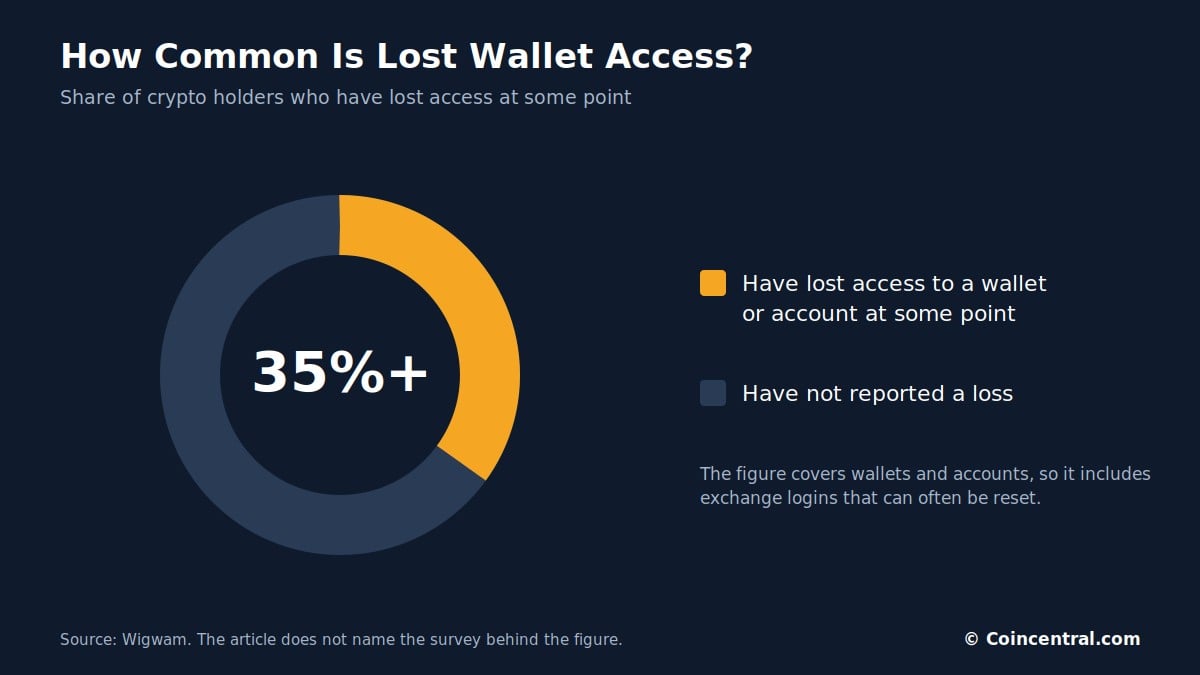
Wigwam reports that over 35% of crypto holders have lost access to a wallet or account at some point. It adds that most of them never get back what they lost. The article does not name the survey behind the 35% figure, so it is best read as a rough guide.
The figure covers both wallets and accounts. An exchange login can often be reset, while a self-custody wallet usually cannot. That means the 35% does not equal 35% of holders losing their coins for good.
Cointelegraph notes that most people run into trouble with non-custodial wallets. It points to hardware failures and forgotten login details as the usual triggers. Wallets such as MetaMask, Trust Wallet and Ledger do not keep your password or seed phrase for you.
Wigwam lists three main ways people lose access. Rango and Coin Wallet add more. The table below puts them together.
| Cause | What happens | Source |
|---|---|---|
| Forgotten password, no seed backup | The user cannot unlock the wallet and has no way to restore it | Wigwam |
| Lost or destroyed seed phrase | Paper is thrown away, burned or lost in a move, so the wallet cannot be restored on a new device | Wigwam |
| Lost or wiped hardware | Keys stored only on a drive, USB stick or old phone are gone with the device | Wigwam |
| Lost 2FA | An authenticator is deleted or a phone is changed, and backup codes were never stored | Rango |
| Seed saved in cloud notes or screenshots | The files are later lost or wiped | Rango |
| Phishing or fake support | The seed phrase is typed into a fake site or given to a fake agent | Rango |
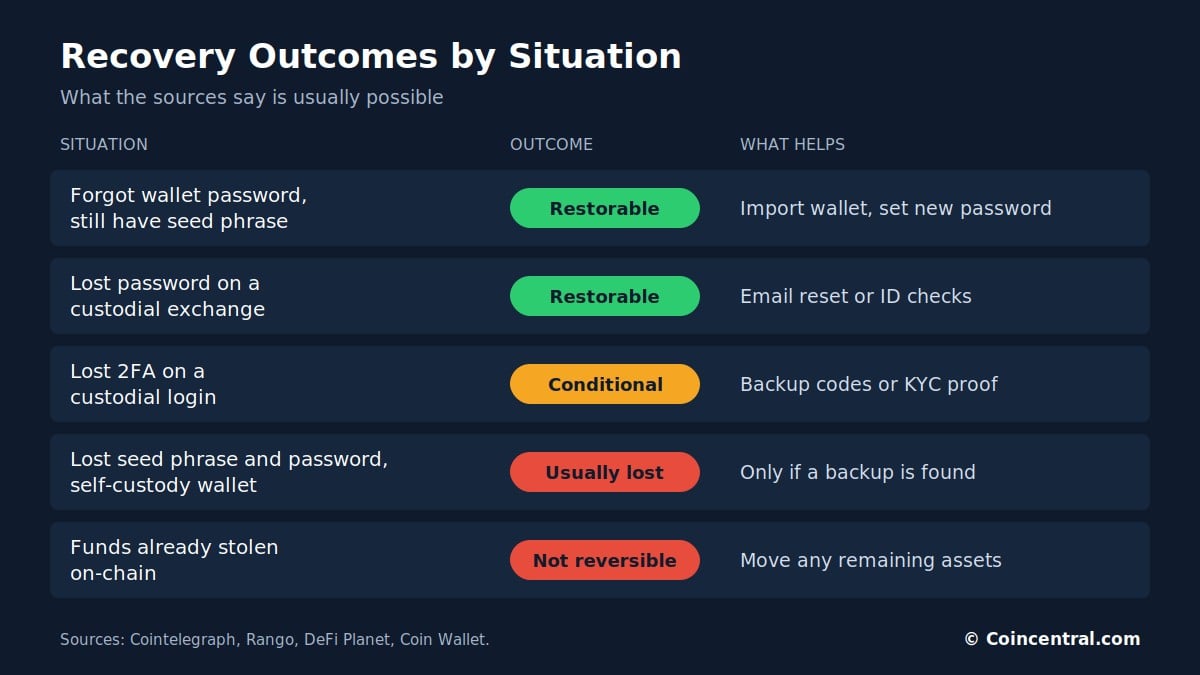
Rango sums up the core risk this way: password loss can be recovered, while seed phrase loss is final. The password only decrypts a key stored on the device. The seed phrase is the root of the wallet.
Rango also warns of a second path to losing access, which is theft. Signs include unexpected approvals, token drains and signature requests you do not recall. Once a seed phrase is exposed, the wallet should be treated as unsafe, even if you can still log in.
Rango points out that many losses are self-inflicted, such as lost keys and weak backups. In its view, the limit on recovery is often set by choices made earlier, not by how fast support responds.
Coin Wallet explains why support cannot help. Its keys are made on your device and kept in the phone’s secure storage. They are never stored on its servers, so the team cannot read or reset them.
Coin Wallet says this is common across the industry. Many self-custody platforms follow the same approach. The trade-off is full control for the user and little recourse when something goes wrong.
Famous Lost Wallet Cases and What They Cost
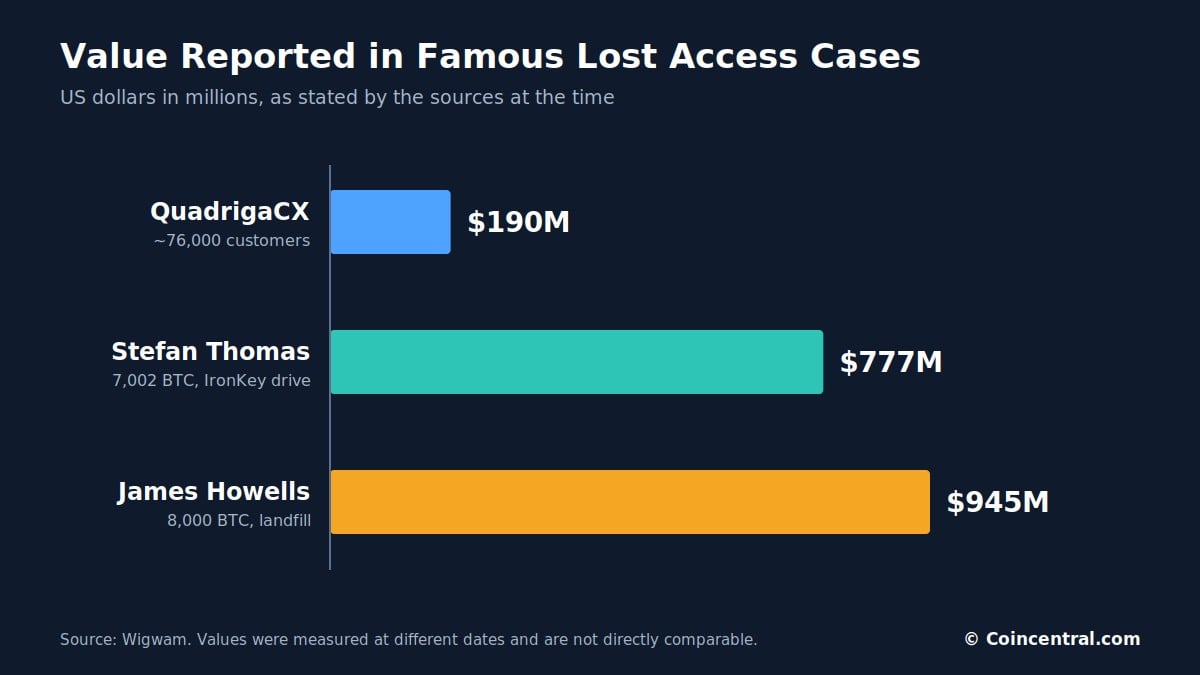
A few cases show how large single losses can get. The dollar values below come from the sources and were measured at different times, so they should not be compared directly.
Stefan Thomas and the IronKey
Stefan Thomas is a German programmer and former CTO of Ripple. In 2011 he received 7,002 Bitcoin as payment for making an animated video about how Bitcoin works. He stored the keys on an IronKey, a hardware-encrypted USB drive that destroys its contents after 10 wrong password attempts.
Thomas lost the paper with the password. By 2021 he had used 8 of his 10 attempts. Wigwam puts the value of the locked coins at $777 million.
Cybersecurity firm Unciphered later said it could crack the drive by taking apart a similar device and reading its microchips. Thomas declined to work with the firm, citing legal and personal reasons. The funds remain locked.
James Howells and the landfill
James Howells, an IT worker from Newport, Wales, mined 8,000 Bitcoin in 2009. In 2013 he threw away a hard drive that held the private keys. The drive ended up in a local landfill.
Howells has asked Newport City Council many times to let him search. He offered to hire a team with ground-penetrating radar, robotic sorting and AI screening, and to share a part of any coins found. The council refused, citing environmental rules, cost and legal liability.
In 2024 he took the council to court. The case was dismissed. Wigwam values the coins at about $945 million at the time it was written.
QuadrigaCX
Gerald Cotten, the 30-year-old founder of QuadrigaCX, died in India in December 2018. QuadrigaCX was Canada’s largest crypto exchange at the time. Cotten was reportedly the only person who knew the passwords to the cold storage wallets, which held about $190 million in customer funds.
His widow, Jennifer Robertson, said in a sworn affidavit that she could not open his encrypted laptop. Experts hired by the company also failed. QuadrigaCX filed for creditor protection in early 2019.
Canadian regulators later found that Cotten appeared to be running a Ponzi scheme. Much of the customer money was already gone before he died. About 76,000 customers recovered only a fraction of what they were owed.
Spread over 76,000 customers, $190 million averages about $2,500 each. That is a rough figure, because balances varied widely.
The three cases share one feature. Each came down to a single point of failure, such as one password, one drive or one person. Wigwam notes that Cotten left no recovery keys with staff, no backups and no written access plan.
The cases also show the limits of outside help. The Unciphered claim shows that technical methods exist for some devices. Even so, the owner must agree to use them, and the Howells case shows that physical access can depend on a local government.
QuadrigaCX differs from the other two in one way. Wigwam notes that it affected thousands of people at once, while the other cases involved one owner each.
| Case | Year | Coins or funds | Reported value | Cause | Outcome |
|---|---|---|---|---|---|
| Stefan Thomas | 2011 (story widely known 2021) | 7,002 BTC | $777 million | Lost password to an IronKey drive | Funds remain locked |
| James Howells | 2013 | 8,000 BTC | About $945 million | Hard drive thrown away | Court case dismissed in 2024 |
| QuadrigaCX | 2018 | About $190 million in customer funds | $190 million | Founder died, only he knew the passwords | Customers recovered a fraction |
Custodial and Non-Custodial Wallets: Who Holds the Keys?
The type of wallet decides most outcomes. In a custodial wallet, the service manages your private key. Cointelegraph names Binance, Kraken and Coinbase as examples.
For these accounts, a lost password is usually fixable. You select “Forgot password,” enter your email, phone or username, and follow the steps.
The exchange may ask security questions or ID documents. Cointelegraph advises adding two-factor authentication afterward.
A non-custodial wallet is different. You hold the keys, and no one else has a copy. The DeFi Planet article puts it plainly: there is no help desk, no “forgot password” button and no recovery email.
Rango explains the role of each secret. The password only unlocks a private key stored on your device. The seed phrase, usually 12 to 24 words based on the BIP-39 standard, can rebuild every key in the wallet.
Coin Wallet adds that a seed phrase can be 12, 15, 18, 21 or 24 words long. It leads to a master key and then to all private keys. A single private key controls only one address.
Some wallets sit between the two models. Rango says MPC wallets and social-login wallets may let the provider keep part of the key. In those cases, recovery can involve ID checks, email or phone codes, and device re-binding.
DeFi Planet lists other tools that help only if they are set up before a loss. They include social recovery wallets, hardware security modules and multisig setups. Biometric systems are also on the list.
Cointelegraph notes that custodial wallets do not offer a seed phrase. The provider handles the management and security of the keys. That is why a custodial login can be reset while a self-custody wallet cannot.
Custodial users face a different risk. Wigwam says that if an exchange collapses or loses funds, as QuadrigaCX did, users may get some money back through insolvency proceedings. It adds that this is typically only a fraction.
DeFi Planet separates losing a wallet from losing crypto. A wallet is only an interface, and the assets stay on the blockchain. A lost app can be fixed with a seed phrase, but funds sent to the wrong address or stolen in a scam cannot be pulled back.
DeFi Planet gives four steps for a restore with a seed phrase. Install a compatible wallet from the official site or app store. Choose the import or restore option, enter the phrase in the right order, and wait for the wallet to sync.
Cointelegraph adds that after a restore the app will ask you to set a new password. This replaces the old one for local access. DeFi Planet also describes the private key as a 64-character code that signs transactions.
| Lockout type | Usually recoverable | Often not recoverable |
|---|---|---|
| Device lost or app deleted | Wallet restored with seed phrase import | Funds, if the seed phrase is also lost |
| Forgot wallet password | Access restored via seed phrase on a new install | Local decryption, if neither password nor seed is known |
| Suspected compromise | Remaining assets moved to a fresh wallet | Confirmed on-chain transfers |
| 2FA loss on a custodial login | Access regained via backup codes or KYC | Recovery, if proof requirements cannot be met |
Rango adds that mistakes during a restore can look like permanent loss. A wrong word order, a mismatched optional passphrase or the wrong derivation path can all block access. Check these before giving up.
Seed Phrase Math, Recovery Odds and Costs
Each word in a seed phrase comes from a fixed list of 2,048 words under the BIP-39 standard. Wigwam says recovery tools can sometimes rebuild a phrase with one or two missing words. Coin Wallet takes the opposite view and says even one missing word makes recovery impossible.
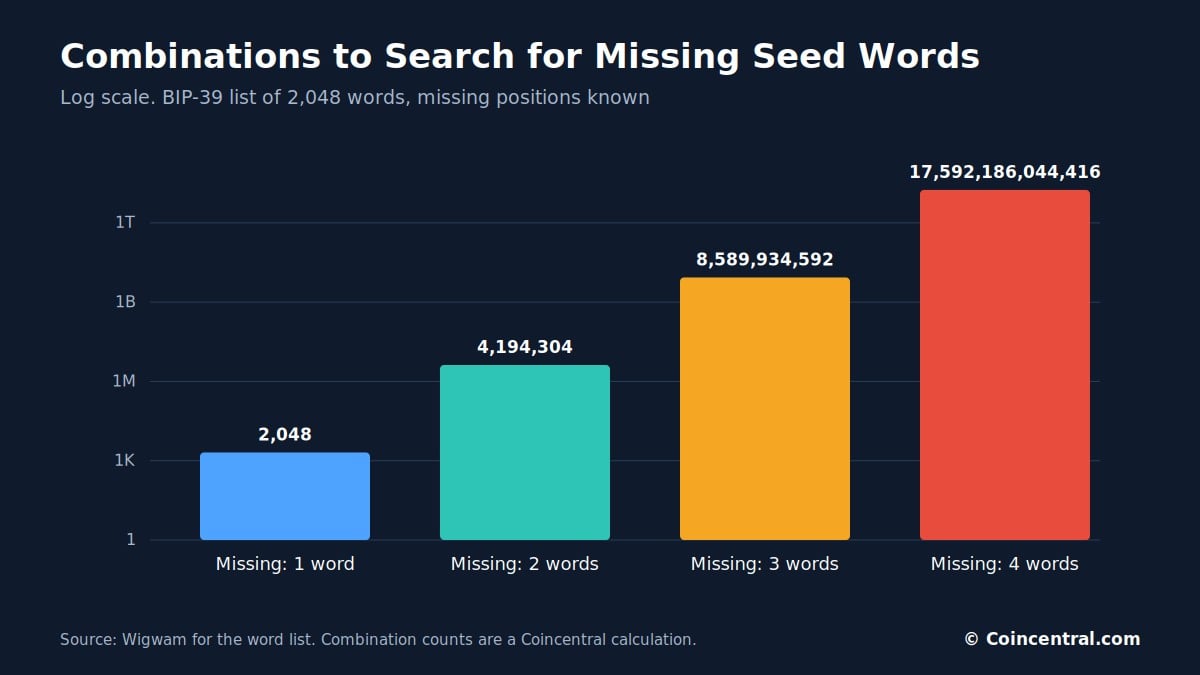
The sources disagree here. The math shows why the question is not simple. If you know which positions are missing, one word means 2,048 options and two words means about 4.2 million.
Three missing words means about 8.6 billion options, and four means about 17.6 trillion. Each added word multiplies the search by 2,048. These counts are our calculation and assume you know which positions are missing and that every other word is right.
| Missing words | Possible combinations | Calculation |
|---|---|---|
| 1 | 2,048 | 2,048 |
| 2 | 4,194,304 | 2,048 x 2,048 |
| 3 | 8,589,934,592 | 2,048 to the power of 3 |
| 4 | 17,592,186,044,416 | 2,048 to the power of 4 |
Password recovery has similar limits. Wigwam says services that use brute-force and dictionary attacks depend on how much you remember. If you remember nothing, the chance is near zero.
Cointelegraph adds that tools exist for wallet file formats, such as .dat files for Bitcoin Core. They work best when the original password was weak or followed a known pattern. It warns against downloading such tools from unknown forums.
Damaged hardware is another path. Wigwam says professional data recovery labs can sometimes pull data from damaged drives. It puts the cost at $500 to $3,000 or more, with no guarantee.
If you saved the phrase somewhere, search first. Cointelegraph suggests checking files ending in .txt or .pdf, password managers, emails, cloud drives and photos of handwritten notes. DeFi Planet adds old devices, keystore files and data recovery tools for recently deleted files.
Forensics firms offer a different service. Cointelegraph says they cannot recover a seed phrase. They may help trace and recover crypto stolen by hackers or scammers if you act fast and have strong evidence.
Cointelegraph also lists legal routes. Theft can be reported to bodies such as Action Fraud or Interpol Cybercrime when the case involves fraud rather than a forgotten password. Civil cases with help from blockchain professionals are another option.
Wigwam lists what does not work. Asking the wallet provider to reset access fails because they cannot do it. There is also no one at the blockchain network to contact.
| Option | What it needs | Cost or limit |
|---|---|---|
| Restore from seed phrase | The full phrase in the right order | Free, works with any compatible wallet |
| Missing word reconstruction | Most of the phrase, a few words missing | Sources disagree on whether it is possible |
| Password cracking service | A partly remembered password or a wallet file | No chance if nothing is remembered |
| Data recovery lab | A damaged drive or device | $500 to $3,000 or more, no guarantee |
| Blockchain forensics | Strong evidence of theft, fast action | Cannot recover a lost seed phrase |
Recovery Scams, Fraud Losses and Prevention
Fraud adds to the problem. The FBI estimated that crypto investment fraud losses topped $9.3 billion in 2024, according to Cointelegraph. Most of those affected were over 60.
Cointelegraph says some victims were hit by recovery scams while trying to get their money back. This makes it important to know what a real firm looks like.
Cointelegraph lists the signs of a real recovery firm. There are no upfront fees, and the firm is paid only if it recovers funds. It starts with a case review of wallet addresses and transaction IDs, and it gives progress reports and realistic timelines.
Real firms also have independent public reviews and clear contact details. Be wary of experts who only use Telegram or Gmail. Avoid anyone who guarantees 100% success.
Wigwam says services that promise guaranteed recovery for upfront payment are almost always scams. Rango says private messages from fake support agents should be treated as malicious. Coin Wallet notes that no legitimate support team will ask for your seed phrase.
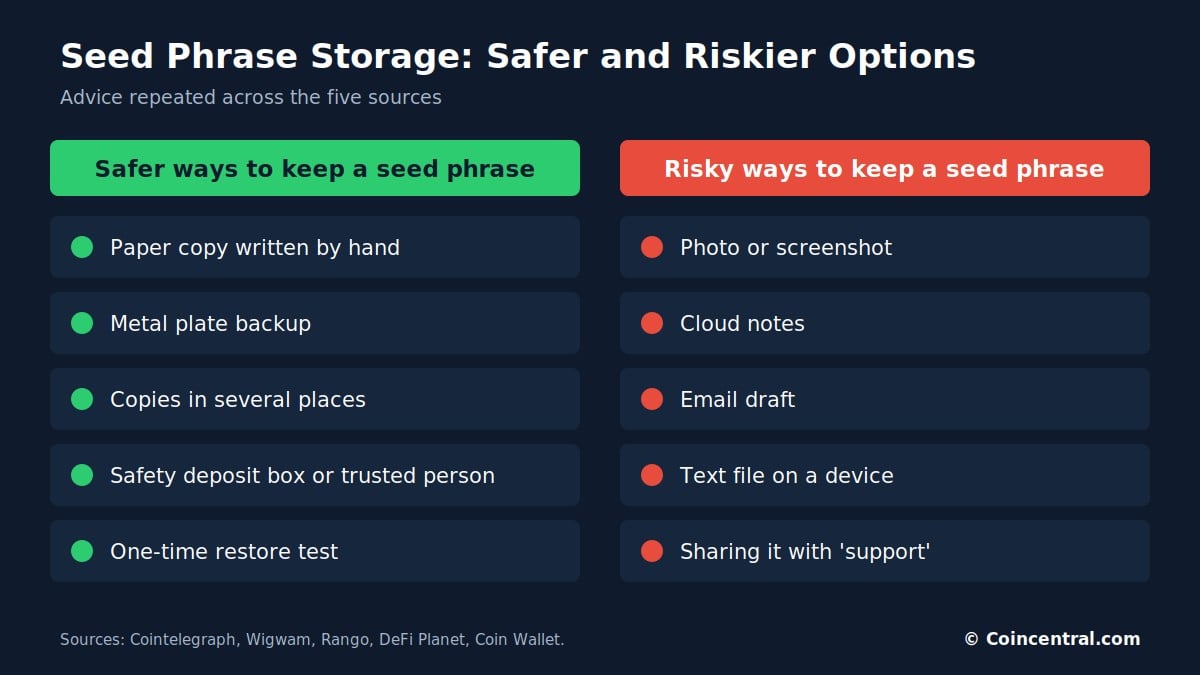
Prevention comes down to backups. Wigwam advises writing the phrase on paper at once and keeping several copies in different places. It says to avoid photos, cloud services and phone notes, and notes that some people use metal plates for fire and water resistance.
Cointelegraph suggests a safety deposit box in another city or a trusted person as a second location. Rango recommends a one-time recovery test. Import the phrase on a second device, check the addresses, then wipe it.
Rango also describes a layered setup. A hot wallet handles frequent use, while a hardware-backed wallet holds long-term funds. Small test transactions come before large transfers.
If you think a wallet has been compromised, Rango says to treat it as a key leak. Use a clean device, create a new wallet, revoke token approvals and move assets in stages. Transfers that already happened on-chain cannot be reversed.
Wigwam promotes a different design, which is an MPC wallet. In this model the private key is split between several secure parties, so there is no seed phrase to lose. The claim comes from a wallet maker, so readers should weigh it with that in mind.
Rango treats the seed phrase as a bearer asset. Whoever controls it controls the wallet, and no fallback exists once it is lost. A password, in contrast, protects local access and can usually be replaced.
Summary
The sources agree on the core point. If you have the seed phrase, access can usually be restored. If you have lost both the password and the seed phrase of a self-custody wallet, access is usually gone for good.
Estimates of lost Bitcoin range from 2.3 million to 6 million coins. Over 35% of holders report losing access to a wallet or account at some point. Exchange accounts can be reset, but self-custody wallets cannot.
Recovery services can help in narrow cases, such as a partly remembered password. They cannot rebuild a missing seed phrase from nothing. Backups made before a loss remain the most reliable protection.
This article is for information only and is not financial advice.
Sources
- Lost your crypto password or seed phrase? Here’s what actually works in 2025 (Cointelegraph)
- What happens to your crypto if you lose access to your wallet (Wigwam)
- What to Do if You Lose Access to Your Crypto Wallet (Rango)
- What Happens If You Lose Your Crypto Wallet? (DeFi Planet via Bitget)
- What to Do If You Have Lost Your Seed Phrase (Coin Wallet)