



Key Takeaways
- Cardano is currently trading in the $0.161–$0.163 range, experiencing slight downward pressure as short positions dominate market sentiment
- Large holders controlling 100,000–100 million ADA tokens have amassed 25.65 billion ADA, marking the highest accumulation rate since February 2023
- Network upgrade Van Rossem is slated for July 18 activation, introducing reduced transaction fees and enhanced smart contract capabilities
- Derivatives market shows futures open interest climbing to $421–$445 million, while the long-to-short ratio of 0.58 indicates bearish sentiment
- Critical liquidity zones at $0.160 and $0.170 represent pivotal levels that may determine ADA’s upcoming price trajectory
Cardano (ADA) is currently hovering between $0.161 and $0.163 as of July 16–17, reflecting a modest decline of approximately 1.39% amid bearish positioning by short sellers in anticipation of an upcoming network enhancement.
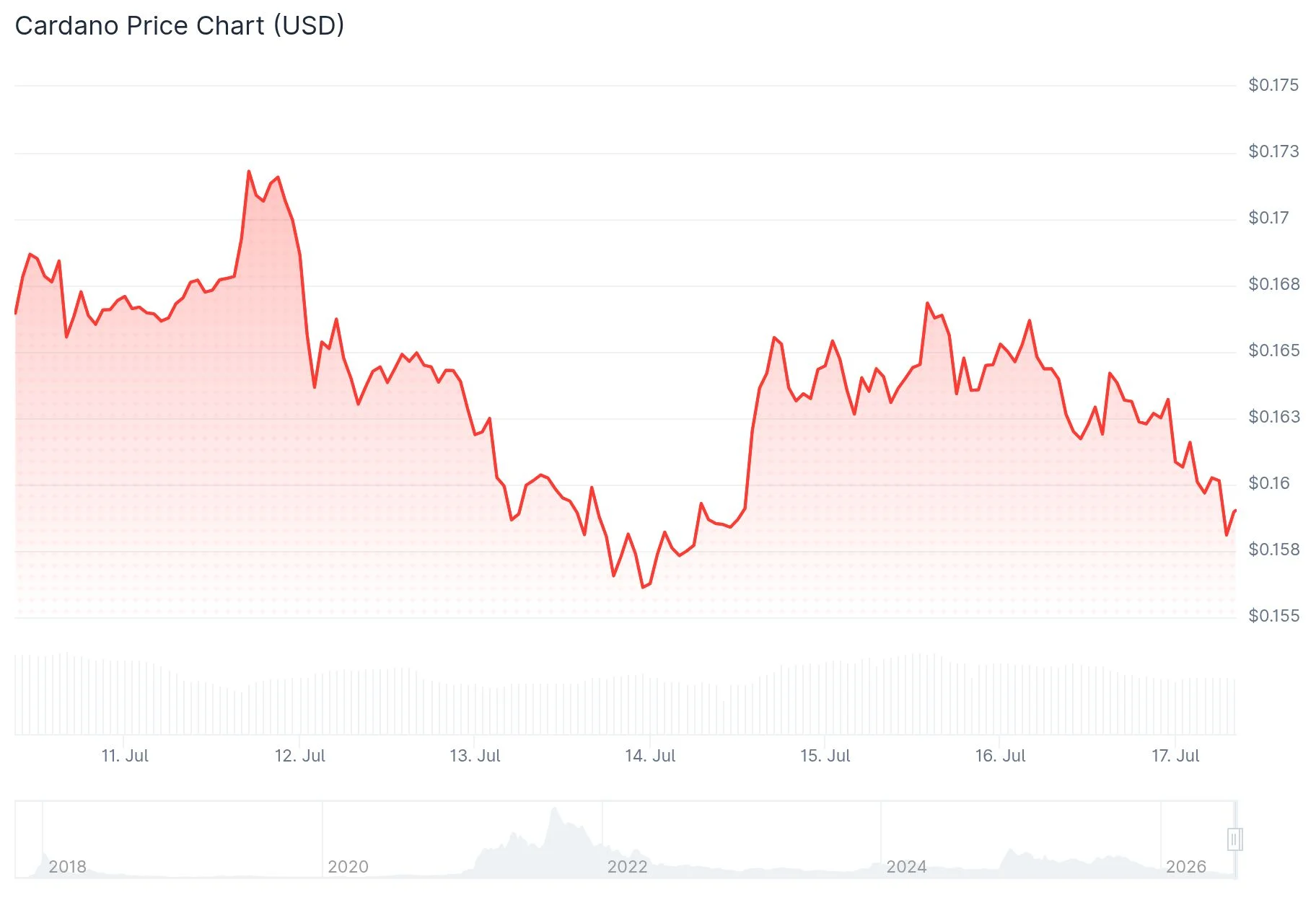
On July 16, ADA experienced price action ranging from a session low of $0.1611 to a peak of $0.1664, representing a retreat from early July’s high near the $0.195 mark.
However, beneath the surface of this price decline, institutional-scale investors are actively accumulating. Wallet addresses containing between 100,000 and 100 million ADA tokens have expanded their holdings to 25.65 billion ADA — a threshold not witnessed since February 2023.
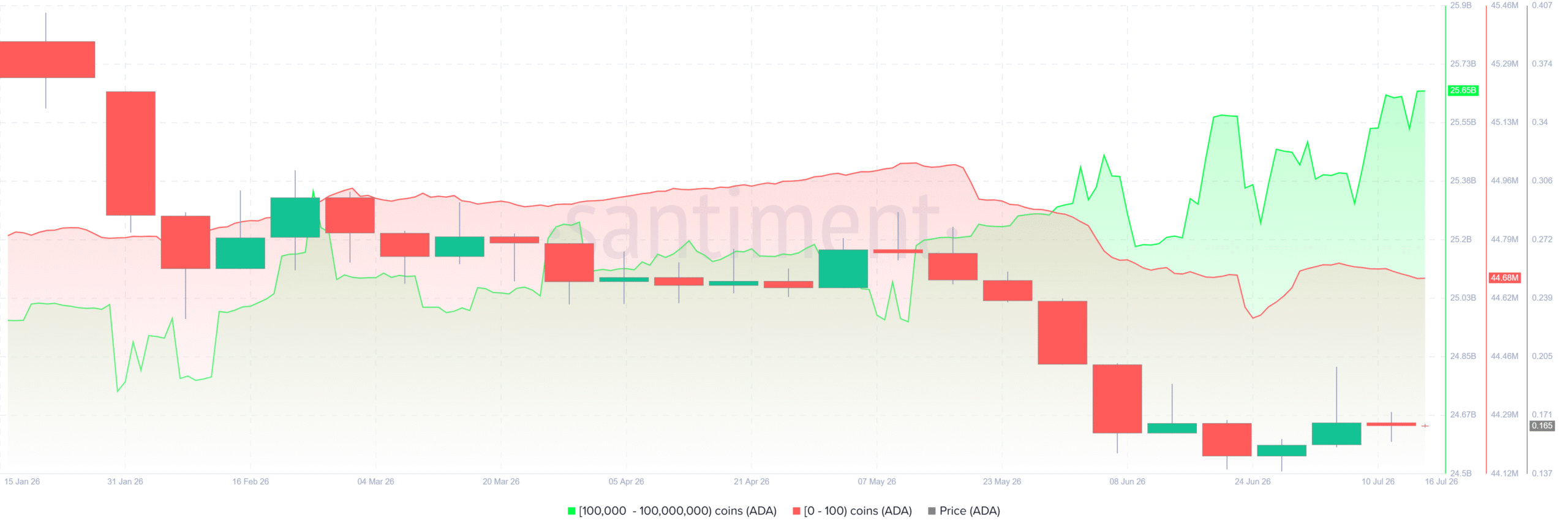
Retail participants present a contrasting narrative. Wallets holding fewer than 100 ADA own approximately 0.7% less compared to four months prior, revealing a divergence between institutional and retail investor behavior.
Futures market indicators suggest near-term bearish positioning. According to CoinGlass, ADA’s weighted funding rate registered at -0.0067%, indicating short holders were compensating long position traders. The long-to-short ratio measured 0.58, while open interest experienced a 4% uptick to approximately $421–$445 million.
Van Rossem Hard Fork: What’s Coming
The Van Rossem hard fork, which received approval from Cardano’s governance structure on July 13, is scheduled to go live on July 18. Intersect, the member-driven organization governing the Cardano ecosystem, has advised all infrastructure operators to implement software updates prior to the transition.
Van Rossem will deliver enhanced Plutus capabilities and reduced execution expenses, resulting in more cost-effective transactions and decentralized applications on the Cardano network. The upgrade also establishes the foundation for Leios, a throughput enhancement targeted for deployment before the conclusion of 2026 designed to expand transaction processing capacity.
From a technical perspective, ADA is positioned beneath the Murrey Math resistance threshold at $0.1709 on daily timeframes. The Relative Strength Index registers between 44–46.92, indicating momentum remains in neutral-to-moderately-bearish territory. The MACD indicator displays minimal positive momentum.
Key Price Levels to Watch
Resistance barriers are positioned at $0.173 (23.6% Fibonacci retracement level), $0.179 (50-day EMA), and a more concentrated zone spanning $0.195 to $0.207. Support infrastructure exists near $0.150, with the June 25 bottom at $0.1382 positioned further below.
CoinGlass’s liquidation heatmap reveals a concentrated liquidity pool between $0.160 and $0.161, positioned immediately below the current trading range. An additional substantial cluster appears around $0.170. A breakdown below $0.160 may catalyze long position liquidations and drive ADA toward $0.1465. Conversely, a breakout above $0.170 could compel short sellers to exit positions and facilitate a price recovery.
Market analyst Celal Kucuker shared on X that he anticipates Cardano will achieve a new all-time high of $5, referencing a bullish divergence on the weekly RSI and characterizing the present zone as a bottom formation. He projected a parabolic rally initiating from current price levels.
ADA continues trading beneath its 50-day, 100-day, and 200-day EMAs positioned at $0.179, $0.208, and $0.276 respectively, confirming the overarching downtrend persists ahead of the July 18 fork implementation.

